
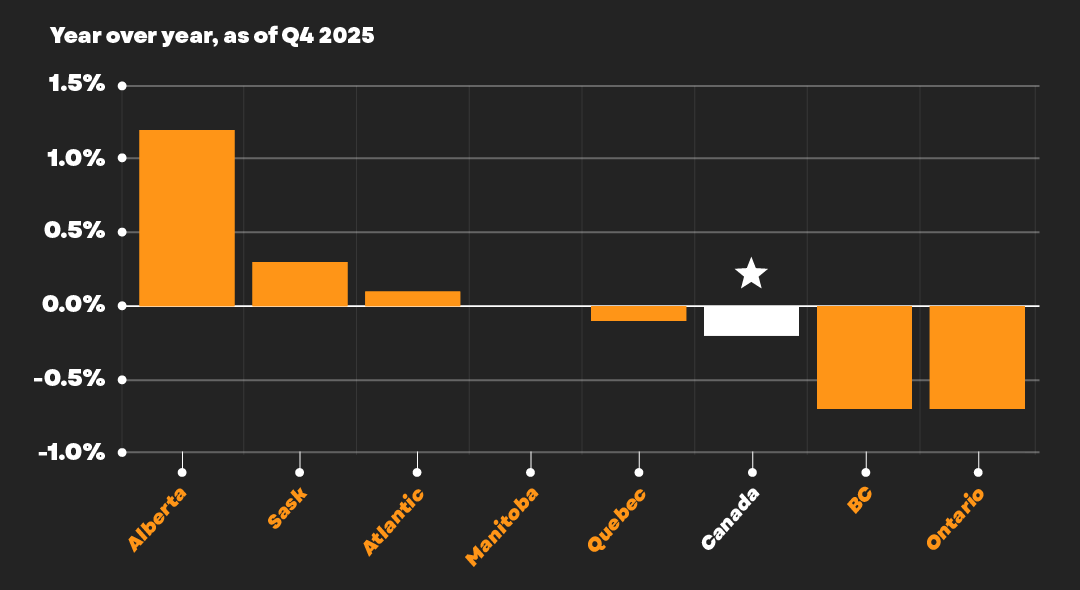
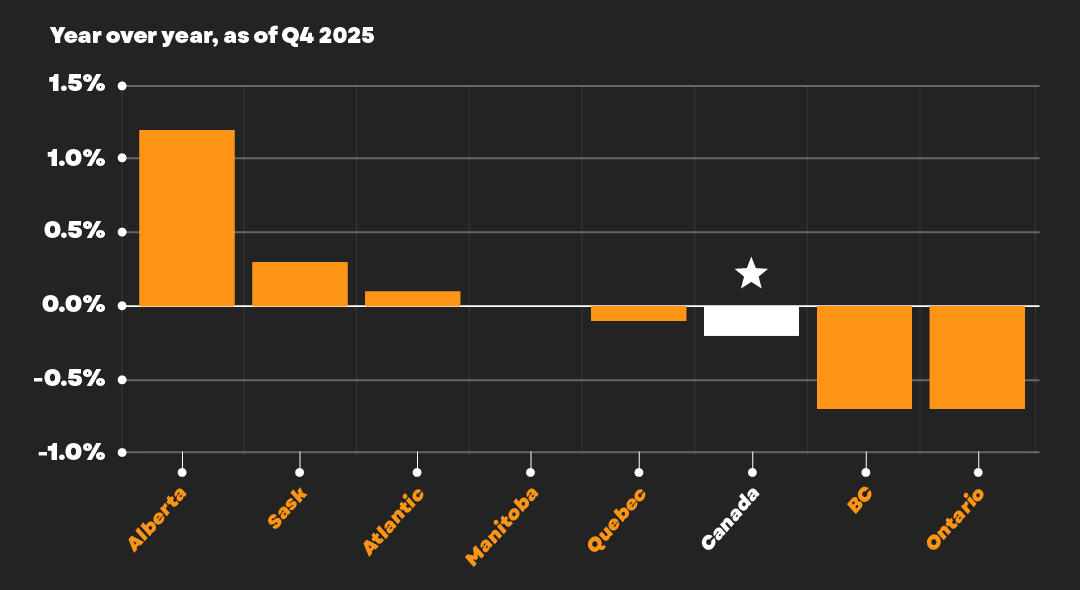
By the end of 2025, Alberta's population shot up by +1.2% year-over-year. Meanwhile, Ontario dipped by -0.7%, and BC dropped -0.75%. These numbers are actively shaping the exact market conditions buyers and sellers are navigating every single day. For the first time since Confederation, Statistics Canada reported that our national population actually shrank in 2025. But here's the catch: it’s not happening everywhere. We’re seeing a massive divide across the country, and figuring out which side of the fence your province sits on is step number one for making smart real estate moves this year.
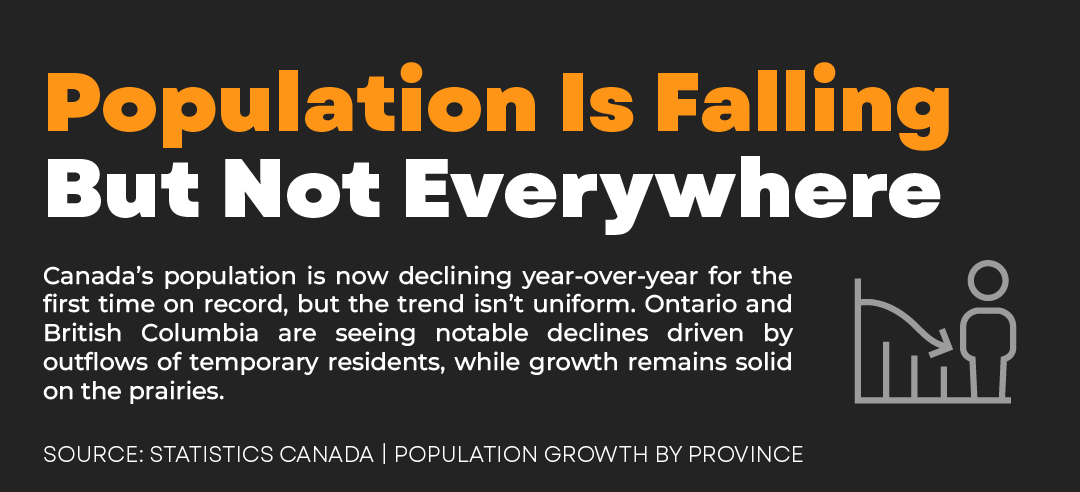
The Population Divide: Province by Province
Alberta is absolutely leading the pack with that +1.2% growth, thanks to a mix of international newcomers and a steady wave of people packing up their cars from Ontario and BC. Saskatchewan is trailing behind at a cozy +0.3%, Atlantic Canada is holding steady near +0.1%, and Manitoba is basically flat. The big takeaway for these provinces? A growing or stable headcount means there's a steady stream of people looking for a place to live, which translates directly into steady housing demand. On the flip side, Ontario and BC are feeling the pinch. BC saw the sharpest drop at around -0.75%, with Ontario right behind at -0.7%. Quebec registered a tiny dip of about -0.1%. Overall, Canada’s total population slipped just below zero—something we’ve literally never seen in recorded history.
Why Ontario and BC Are Losing Residents
So, what's driving the sudden drop in Ontario and BC? It all comes down to a deliberate policy shift. Back in 2024, the federal government set out to trim the number of temporary residents from 7.6% down to 5% of the total population by 2027. Because of that, about 461,000 temporary residents, international students, and temporary foreign workers ended up leaving—and most of them were living in the two provinces that usually take in the biggest shares.
To put it in perspective, Toronto saw nearly 80,000 people pack up and move to smaller Canadian cities, and Vancouver lost close to 21,000. The ripple effect on real estate happened fast: rental vacancy rates climbed, advertised rents hit a 33-month low by February 2026, the GTA is flooded with condo listings, and investors are stepping back because the math on rental income just isn't panning out. Because of this, benchmark prices are down 6.5% year-over-year in Ontario and about 5.8% in BC.
This isn't just a typical dip in the market. It’s a major structural shift with a very specific cause.
Why Alberta and the Prairies Are Different
Alberta’s boom isn't just luck. It's a sign of where Canadians are choosing to put down roots. People from Ontario and BC are moving inland looking for cheaper housing, a lower cost of living, and better job opportunities. When you look at the math, it makes sense: Calgary’s benchmark home price was $591,900 in March 2026, which gives you way more bang for your buck than Toronto or Vancouver. Edmonton is even more accessible with a benchmark of $413,700, making it one of the most affordable big cities in Canada. Those are fantastic entry points if you're moving from either coast.
Saskatchewan and Atlantic Canada are riding a similar wave. They’ve got positive migration, relatively affordable homes, and low inventory, which is keeping prices steady and sellers confident. It’s a completely different world compared to the oversupplied, price-dropped markets in BC and Ontario.
Strategic Implications for Buyers and Sellers
If you’re a buyer in Ontario or BC, you’re looking at a market where the usual crazy demand has really cooled down. This has opened up a buying window we haven’t seen in almost a decade. There are plenty of homes to choose from, you actually have leverage to negotiate on prices and closing costs, and benchmark prices are lower than they were in 2025. Your best move right now is to get prepared: secure your mortgage pre-approval, find a sharp local agent who knows where prices actually stand today, and be ready to pull the trigger when the right spot pops up. CMHC expects things to start bouncing back in 2027, so the buyers who get ready in 2026 are going to win big.
Now, if you’re buying in Alberta or the Prairies, it’s a whole different ballgame. Population growth is keeping demand high, and properties that are priced right are still seeing plenty of competition. You absolutely need a solid comparative market analysis of your target neighborhood before you start writing offers. If you’re wondering whether Alberta is still a smart buy in 2026, the population data says it all: no other province has stronger, people-driven demand pushing the market forward right now.
For sellers in Ontario and BC, you’ve got to check your emotions and look strictly at today's benchmark numbers. Wishing for a higher price won’t work in a market where demand has taken a hit. Things like curb appeal and home staging matter way more in a buyer's market than you might think. Get a professional home valuation based on what's selling right now, not the peak prices of 2023 or 2024.
On the flip side, sellers in Alberta and the Prairies are holding some of the best cards in the country. Thanks to a growing population and tight inventory, you can expect above-average price outcomes if you play it right. Your best bet is to list your property while these conditions last, before a wider national recovery brings more competing sellers onto the market.
Frequently Asked Questions
Why did Canada's population decline in 2025?
For the first time since Confederation, Canada’s population actually shrank by over 100,000 people. The big reason? A net drop of about 461,000 temporary residents, international students, and temporary foreign workers. This happened after federal policy changes in 2024 aimed to lower the non-permanent resident population from 7.6% down to 5% by 2027. Since Ontario and BC usually welcome the most temporary residents, they took the biggest hits, with both provinces dropping by about -0.7%. This isn't an economic collapse—it’s just a direct reaction to a major policy shift.
How does Canada's population decline affect housing prices?
When a population drops, housing demand naturally cools off. Fewer people means fewer new households, less pressure on rentals, and less bidding wars for buyers. In Ontario and BC, where the drop is most obvious, benchmark prices are down 5–7% year-over-year. Rental vacancies are up, rents hit a 33-month low by February 2026, and there's a big backlog of condos on the market. But if you look at provinces where the population is still growing—like Alberta and the Prairies—demand is holding up just fine, keeping inventory low and prices steady. It’s a tale of two completely different realities in the same country.
Why are people leaving Ontario and BC, and where are they going?
There are two main things happening at once. First, you have temporary residents leaving due to those federal immigration changes, which accounts for the biggest chunk of the numbers. Second, you have Canadians moving between provinces to find affordable housing. In 2025, Toronto saw nearly 80,000 people leave for smaller Canadian cities, while Vancouver lost about 21,000. Most of them are heading straight for Alberta to take advantage of cheaper homes, a great job market, and a lower cost of living. Saskatchewan and Atlantic Canada are also getting a nice slice of that pie. The 2026 migration data makes Alberta’s growth story crystal clear.
Will Ontario's housing market recover after the population drop?
It should recover, but it’s going to be a slow climb rather than a quick bounce. According to the CMHC 2026 Housing Market Outlook, Ontario is looking at a slower recovery, with home sales expected to stay below 10-year averages because of affordability hurdles and less population-driven demand. The GTA condo market has the biggest supply backlog to work through before prices can really steady out. While Ontario's long-term outlook is still solid, don't expect a fast rebound. Buyers who get into position now might just catch a great window of opportunity before all that pent-up demand returns.
Which provinces are seeing population growth and what does it mean for real estate?
Looking at the Q4 2025 Statistics Canada data, Alberta is up +1.2%, Saskatchewan is up +0.3%, Atlantic Canada is hanging around +0.1%, and Manitoba is pretty much holding flat. In these areas, growing populations mean less inventory, steadier benchmark pricing, and better conditions for sellers. The Prairies, in particular, are seeing a great mix of population growth and affordable housing stock, creating fantastic opportunities for buyers and investors in 2026. It might not get the same massive headlines as Alberta, but the fundamentals are just as solid.
Data sourced from Edge Analytics, Statistics Canada Population Growth by Province Q4 2025. Supporting analysis from TD Economics Provincial Housing Outlook March 2026, RBC Economics Canadian Housing Analysis, and CMHC Housing Market Outlook 2026.
Posted by Christopher Audette on
Leave A Comment