
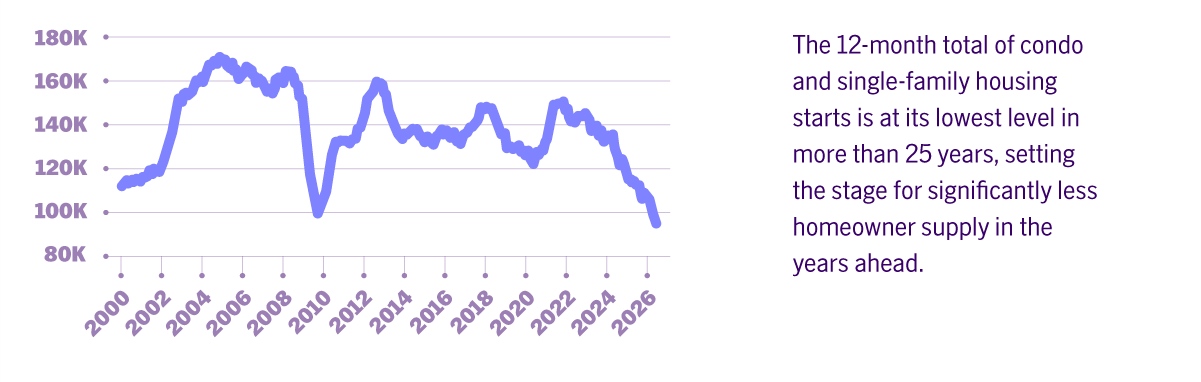
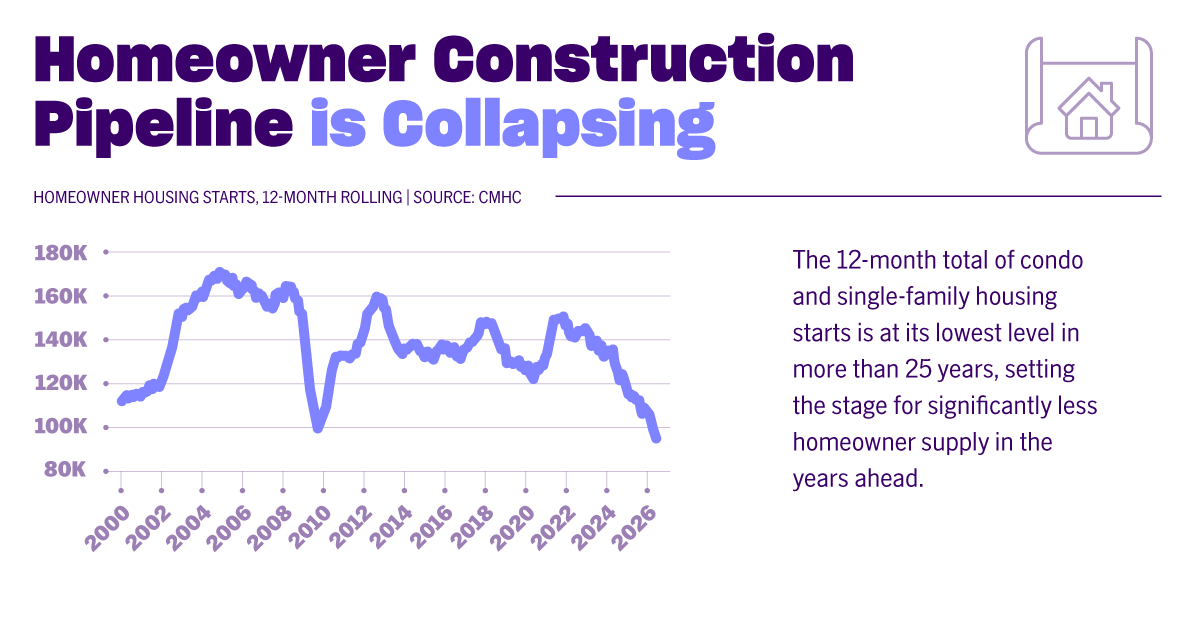
Why is there a housing shortage in Canada right now? It has more to do with the new construction pipeline than the high cost of home ownership in Canada. Homeowner housing starts have dropped to their lowest level in more than 25 years, a steeper decline than what followed the 2008 financial crisis.
National price data doesn’t expose this. The average home in Canada sold for $674,819 in July 2026, up a slim 0.2% year-over-year, and CREA's benchmark index was down 3.3%, its smallest yearly drop in nearly a year, while sales rose for a fourth straight month. Look past those numbers, though, and the shortage is on the supply side: CMHC reports homeowner starts fell to a seasonally adjusted 229,074 units in July, down 5% month-over-month and the slowest sustained pace in a quarter-century. Fewer homes breaking ground now means fewer completions two to three years out, no matter what today's prices suggest.
And the shortage isn't landing everywhere the same way. Quebec's benchmark price is up 3.2% year-over-year, New Brunswick 6.7%, and Newfoundland and Labrador 9.3%, tighter local supply already showing up in price growth. Ontario (-3.9%) and B.C. (-4.9%) haven't felt that squeeze yet; both are still working through inventory left over from before the slowdown. That cushion won't last forever if construction keeps slipping nationally.
Buyer Takeaways
- What's actually scarce is new construction, not resale, widen your search to include existing homes.
- Get pre-approved and compare mortgage rates in Canada now, before the shortage tightens things further.
Seller Takeaways
- In Ontario or B.C., price to today's numbers (-3.9%, -4.9%) rather than waiting on the shortage to catch up.
- Book a home valuation before you list, the shortage's price effects vary a lot by province.
Talk to a Local Agent Before Supply Tightens Further
With CMHC reporting the fewest new homeowner starts in 25 years, competition for existing homes is likely to intensify. Connect with a local agent today. Find an Agent →
Frequently Asked Questions
Why is there a housing shortage in Canada, and will it get worse?
It comes down to builders pulling back while demand hasn't slowed to match. Starts are at a 25-year low per CMHC, and that gap tends to widen before it narrows.
Will house prices go up if new construction keeps slowing?
Likely, once demand catches up. The average home price sat at $674,819 in July 2026 (+0.2% YoY), while the benchmark index was still down 3.3% annually, per CREA. With sales up four months running, tighter supply could push prices higher within 12–18 months.
What does declining housing starts mean for buyers, and are condo presales still available?
Fewer new-build options and more competition for existing homes. Expect fewer condo presale launches and longer waits, especially in Vancouver, Calgary, and Toronto, where builders have pulled back hardest.
How do I find new homes for sale near me?
An MLS® search paired with a local real estate agent is best. National sales rose 0.5% month-over-month in July, per CREA, a local agent can flag listings before their widely seen and book showings quickly.
Data attribution: CMHC (Housing Starts and Construction Data, July 2026); CREA (National Statistics, July 2026); Bank of Canada (Rate Announcement, September 2, 2026).
Posted by Christopher Audette on
Leave A Comment