
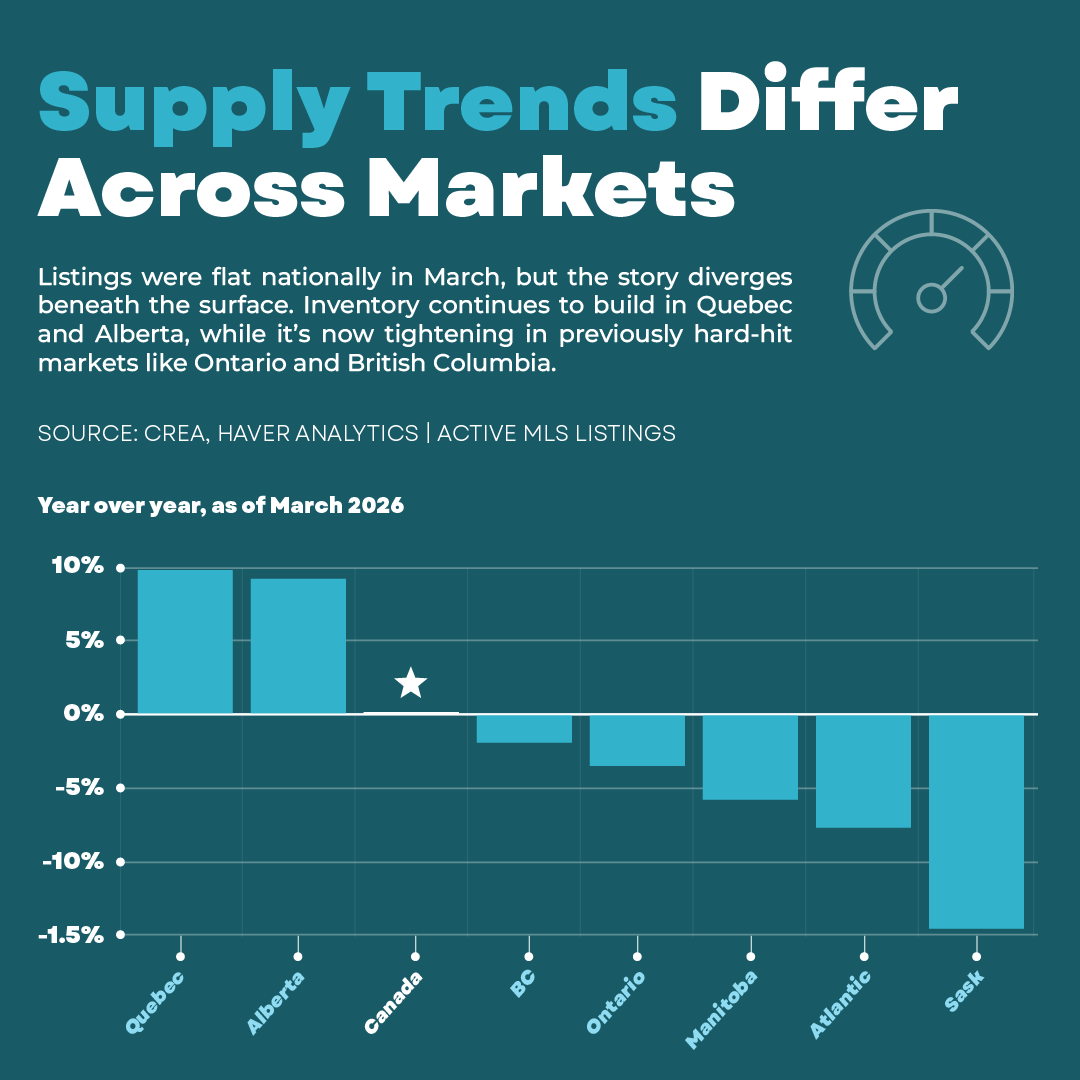
Saskatchewan home listings dropped 13% year-over-year in March 2026. Meanwhile, Quebec and Alberta saw inventory climb nearly 9%. Same country, same month, completely opposite markets. If you're making a buying or selling decision based on national headlines, you're likely reading the wrong data.
According to CREA and Edge Analytics, active MLS listings across Canada were essentially flat year-over-year as of March 2026. That national figure is technically accurate, and almost entirely misleading. Beneath it, Canadian real estate inventory is moving in sharply opposite directions depending on where you live.
Where Inventory Is Building: Quebec and Alberta
Both Quebec and Alberta posted year-over-year inventory gains of approximately 9%, the strongest growth among all tracked markets. For buyers, that means more options, more time to decide, and more room to negotiate on price and conditions.
For sellers, the picture is more competitive. With supply building steadily, pricing strategy matters more than ever. Well-priced, well-presented homes are still moving, but overpriced listings now face a market with real alternatives. If you're weighing whether to sell your house in Quebec in 2026, the data supports acting, but with a realistic pricing strategy from the start.
Where Supply Is Tightening: Ontario, BC, Manitoba, Atlantic Canada, and Saskatchewan
Five provinces are trending in the opposite direction, and the declines are significant. Ontario and BC recorded year-over-year drops in active listings of roughly 4%, continuing a tightening trend in two markets that had previously seen inventory corrections. Manitoba and the Atlantic region fell further, in the 6–8% range.
Saskatchewan saw the sharpest decline of all: approximately 13% fewer active listings year-over-year. For buyers in these markets, the window to act is narrowing.
Knowing how to buy a house in a tight market, whether that's BC, Ontario, or Saskatchewan, starts with preparation well before you find a property you want. Getting pre-approved for a mortgage before you begin your search is no longer optional in these provinces; it's the baseline. From there, acting decisively on well-priced properties and working with an agent who has real-time knowledge of local inventory conditions are the two factors that most often separate buyers who close from those who keep losing out.
For sellers in tightening markets, reduced competition is a meaningful advantage. Fewer listings generally supports stronger offers, faster timelines, and less pressure to negotiate down.
Why the National Average Is the Wrong Number to Watch
The best time to buy a house in Ontario in 2026 is shaped by Ontario's inventory reality, not Alberta's surplus. A seller in Saskatchewan is operating in a fundamentally different environment than one in Quebec. The national average flattens all of that into a number that describes almost no one's actual market.
Here's what the data actually says for your decision:
- Buyers in low-inventory markets (Ontario, BC, Saskatchewan, Atlantic Canada): prioritize preparation over perfect timing. Get pre-approved, know your criteria, and be ready to move when the right property appears.
- Buyers in higher-inventory markets (Quebec, Alberta): use the surplus to your advantage. Take time to compare options, request conditions, and negotiate, the market is currently on your side.
- Sellers in tightening markets: a well-positioned listing has the advantage right now. Lean into that with strong presentation and confident pricing.
- Sellers in surplus markets: competitive pricing and standout presentation are non-negotiable. The buyers are there, but so are your competitors.
The Bottom Line
Canada's March 2026 housing supply data makes one thing clear: the national narrative and your local reality are not the same conversation. The province you're buying or selling in is the only number that truly matters.
Find out what supply trends mean for your province. Connect with a local agent today for a free, no-obligation consultation.
Data sourced from CREA and Edge Analytics, active MLS listings as of March 2026.
Frequently Asked Questions
Why are housing listings flat nationally but different by province in March 2026?
National active MLS listings were essentially unchanged year-over-year in March 2026, according to CREA and Haver Analytics. But that flat national number conceals a sharp regional divergence — Quebec and Alberta saw inventory build by approximately 9% each, while provinces like Saskatchewan, Atlantic Canada, and Ontario saw active listings decline by 4–13%. The national figure averages out two opposite trends happening simultaneously.
Why is housing inventory rising in Quebec and Alberta?
Quebec and Alberta are seeing inventory build for different reasons. In Quebec, new listings have increased as sellers respond to strong demand and record benchmark prices — the province's benchmark hit $549,400 in March 2026. In Alberta, new listings growth reflects a combination of population-driven demand encouraging new builds and sellers entering a market with 2.8 months of supply — one of the tightest in Canada. Rising inventory in both provinces has not yet softened prices, as demand continues to absorb new supply.
Why are homes selling fast in Ontario and BC despite tightening supply?
Although Ontario and BC are seeing year-over-year declines in active listings, homes are selling faster in certain segments because supply has dropped more sharply than demand in some areas. In Metro Vancouver, new listings fell 10.3% year-over-year in March 2026 while sales declined only 2.8% — meaning the inventory drawdown is outpacing the demand decline in specific segments. In Ontario, detached housing is showing faster movement than the condo segment, where supply remains elevated.
Should I sell my house now in Quebec given rising inventory?
Yes — rising inventory in Quebec does not signal a weakening market. Quebec's benchmark price hit a record $549,400 in March 2026 for the third consecutive month, and the sales-to-new-listings ratio remains favourable to sellers. New listings are being absorbed by active buyer demand. Sellers who price competitively and present their homes well are achieving strong results. The strategic risk in Quebec is waiting, not acting — conditions remain firmly in the seller's favour.
Is now a good time to buy in Atlantic Canada given low inventory?
Atlantic Canada's inventory has declined year-over-year, creating tighter conditions for buyers — but the region still offers significantly better affordability than Ontario or BC. For buyers, the declining inventory trend signals that waiting is unlikely to produce better conditions or lower prices. Newfoundland's benchmark price rose 9.3% year-over-year in March 2026, and with active listings near multi-decade lows, the window for entering at current prices may be narrowing. Getting pre-approved and working with a local agent is the recommended first move.
What do tightening supply trends in Ontario and BC mean for sellers?
Year-over-year declines in active listings in Ontario and BC are a cautiously positive signal for sellers — less competition means better conditions than were present at the inventory peak. However, this tightening has not yet translated into price recovery; Ontario benchmark prices were still down 6.5% and BC down approximately 5.8% year-over-year as of March 2026. Sellers in these markets benefit from pricing to current benchmark data and ensuring their listing stands out, as buyers remain selective in markets with elevated overall supply relative to historical norms.
Leave A Comment