
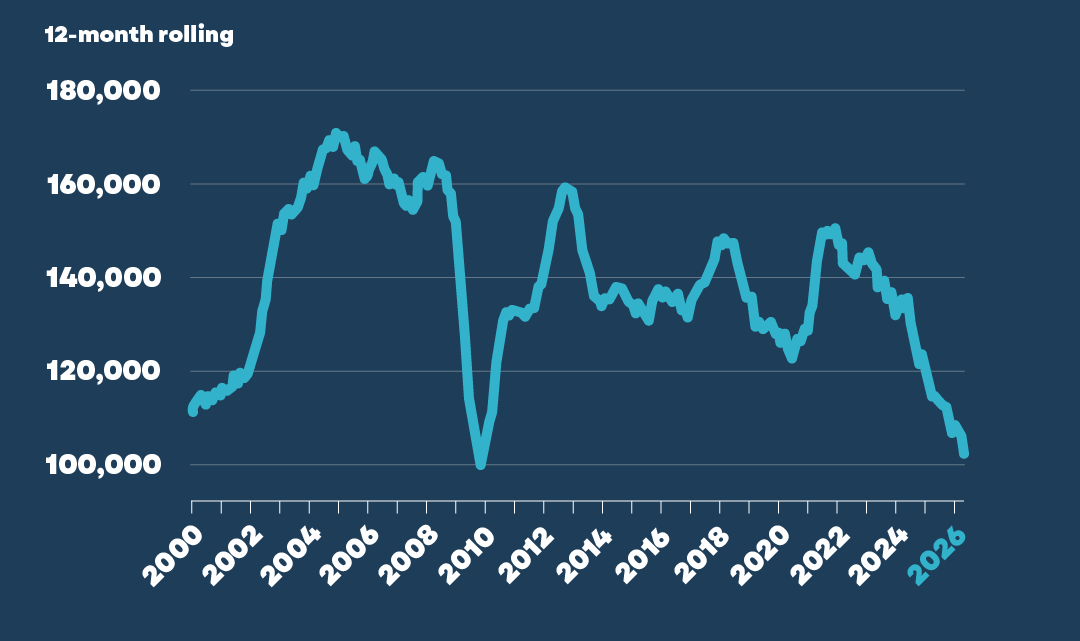
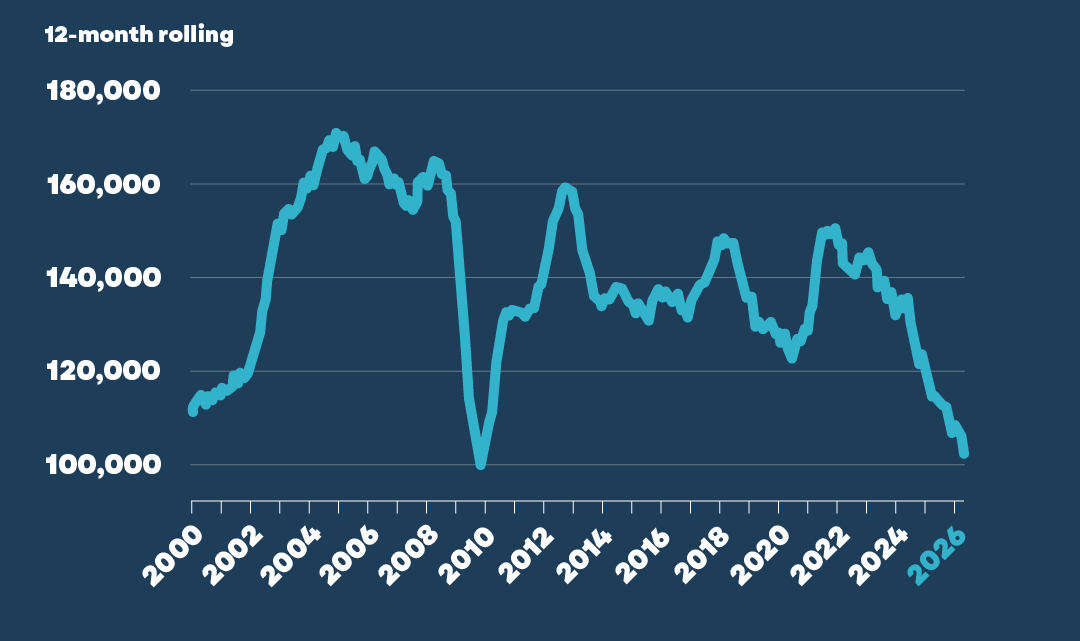
That headline isn't an exaggeration. It's data straight from CMHC. Canadian ownership housing starts have fallen to approximately 100,000 units on a 12-month rolling basis in 2026, matching the lowest level ever recorded in the dataset. The last time the Canadian residential construction sector was here was 2010, right after the global financial crisis. And what happened in the years that followed should be on every buyer's and seller's radar right now.
What "Housing Starts" Actually Means, And Why It Matters
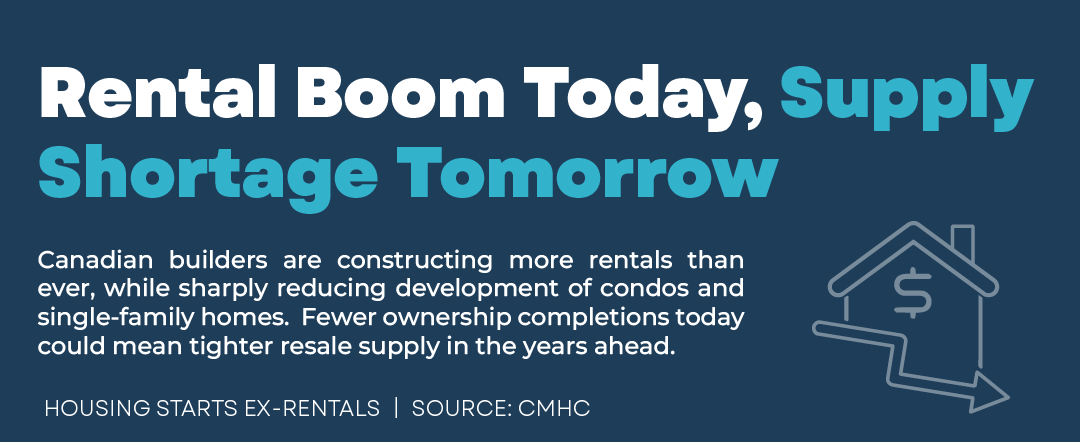
A housing start is counted when construction begins on a new residential unit. The figure CMHC tracks as "ex-rentals" measures specifically the condos and single-family homes that will eventually be available for Canadians to buy, not purpose-built rental units. It's the most direct leading indicator of future ownership housing supply in the Canadian market.
When that number drops, it doesn't show up immediately in resale inventory. There's a lag. A home that doesn't get started today won't reach completion for another 18 to 36 months. So the real pain of today's 26-year low in ownership starts won't be fully felt until 2027 and 2028, when the completions pipeline comes up short and buyers find themselves competing for a shrinking pool of available homes.
That's why this number matters right now, even if you're not planning to move for another year or two. The supply clock is already ticking.
How Did We Get Here?
Three structural forces combined to push Canadian ownership starts to their lowest level in a generation.
High construction costs. Material and labour costs have risen dramatically since the pandemic, making new ownership projects far more expensive to build and far less profitable to sell at current price points. For many developers, the pro forma on an ownership project simply doesn't pencil out in today's cost environment.
Elevated mortgage rates. Higher mortgage rates don't just affect buyers. They suppress pre-sale condo demand, and builders rely on pre-sale purchases to secure construction financing before breaking ground. When buyers can't qualify or choose to wait, pre-sale absorption dries up and projects get shelved before a single unit is framed.
The rental capital shift. Institutional investment capital has flooded into purpose-built rental construction, where landlord and investor demand remains strong. Builders follow the financing. And right now, the financing is in rentals, not ownership homes.
The result is a construction sector that is busier than ever. Just not building what buyers need.
What This Means If You're a Buyer
- Fewer starts today means fewer homes to buy in 2027 and beyond. The ownership supply pipeline is draining in real time and won't refill quickly given current construction economics and the continued shift of builder capital toward purpose-built rentals.
- Waiting for supply to improve is not a strategy. At current build rates, the ownership supply gap will widen before it narrows. Buyers who hold out for more inventory may find themselves entering a significantly tighter resale market at higher price points.
- Mortgage pre-approval now means you're ready to move the moment the right home appears. In a tightening resale market, the prepared buyer consistently wins over the buyer who is still arranging financing.
See What's Still Available in Your Market
With ownership housing starts at a 26-year low, the pool of available homes is shrinking faster than most buyers realize. Don't wait for the headlines to catch up. Browse current listings or get pre-approved today before competition intensifies.
What This Means If You're a Seller
- Your resale home is becoming rarer. With ownership starts at a 26-year low, there will be fewer newly built alternatives for buyers to consider, which shifts more buyer attention toward existing resale properties.
- Less new supply means more demand pressure on resale inventory. Well-priced existing homes in good condition will attract more motivated buyer interest as the new construction pipeline continues to thin. Days on market (DOM) tends to compress when new build alternatives disappear.
- Pricing accurately today is what gets your home sold. Buyers who are active in a soft market are the most motivated buyers in the market. A comparative market analysis (CMA) grounded in current comparable sales data, not 2021 peak assumptions, is what converts that motivation into a signed agreement.
Find Out What Your Home Is Worth in a Tightening Market
Fewer new ownership homes being built means your existing property is becoming increasingly scarce. In a supply-constrained market, accurate pricing isn't just smart. It's your biggest competitive advantage. Get a free home valuation today.
The Bottom Line
A 26-year low in Canadian ownership housing starts is not just a number. It's a signal. It tells you the supply of homes available to buy is going to get tighter before it gets better. It tells you that builders who should be filling that gap have redirected their capital elsewhere. And it tells you the window to act ahead of that tightening is open right now, not in two years when the shortage shows up in every headline and competition has already intensified.
Ready to Buy Before the Supply Runs Out?
Canadian builders are shifting away from ownership housing at the fastest pace in 26 years. The window to buy before resale inventory tightens further is narrowing. Connect with a local agent who knows exactly what's available in your market right now.
Frequently Asked Questions
Why are Canadian builders constructing more rentals than ownership homes?
Canadian builders are shifting to purpose-built rental construction because softening pre-sale condo demand, elevated mortgage rates, and rising construction costs have made ownership projects financially riskier to launch. According to CMHC data, rental housing starts have surged while ex-rental starts, covering condos and single-family homes, have fallen to approximately 100,000 units on a 12-month rolling basis in 2026, the lowest level since 2000. Builders follow demand signals and construction financing availability, and right now, institutional rental demand is considerably stronger than pre-sale buyer absorption across most major Canadian markets.
Is Canada's housing supply shortage getting worse in 2025?
Yes. Canada's ownership housing supply shortage is measurably worsening. CMHC data shows ex-rental housing starts on a 12-month rolling basis have fallen to approximately 100,000 units, the lowest level in 26 years and matching the post-financial-crisis trough of 2010. Combined with federal immigration targets of 400,000+ newcomers per year and chronic underbuilding across major urban centres including Toronto, Vancouver, and Calgary, the gap between housing demand and ownership supply continues to widen heading into 2026 and beyond.
How do falling housing starts affect home sellers in Canada?
Falling ownership housing starts are a medium-term tailwind for resale sellers. As new ownership supply entering the market shrinks over the next 3 to 5 years, existing homeowners holding resale properties will face less competition from newly built homes. CMHC data projecting continued undersupply in major urban markets suggests that well-priced resale homes in supply-constrained cities like Toronto, Vancouver, and Calgary will attract stronger buyer demand as the ownership supply pipeline thins and pre-sale condo absorption remains weak.
Data Attribution: Housing starts ex-rentals data sourced from CMHC (Canada Mortgage and Housing Corporation), 12-month rolling basis, 2000 to 2026. Supporting context drawn from the CMHC Housing Market Outlook, Statistics Canada population and immigration data, and TD Economics Provincial Housing Outlook.
Posted by Christopher Audette on
Leave A Comment