
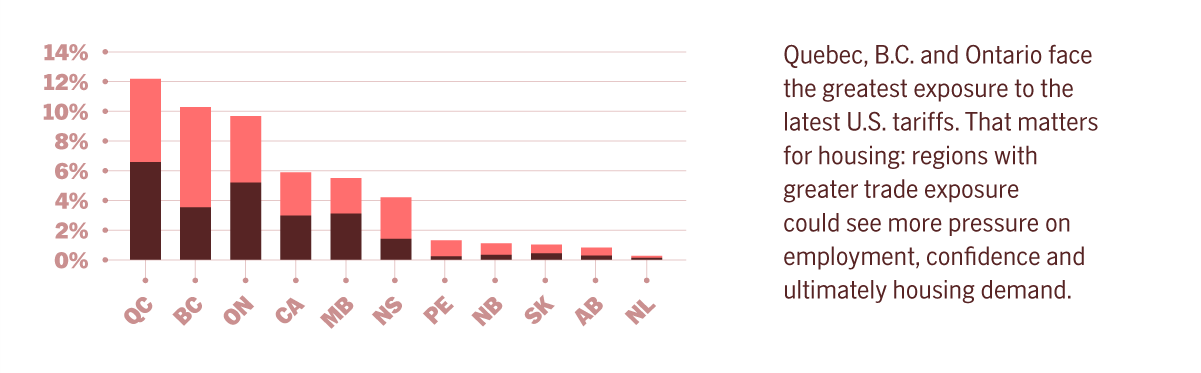
The most recent Trade War between the current US Government and Canada has greater impact than just higher prices at the register for certain goods. Tariffs reach housing through a chain, not a straight line: trade exposure hits specific industries, industries hit local employment, employment hits buyer and seller confidence, and confidence eventually hits housing demand. That chain is what helps you read any future tariff development, not just this one.
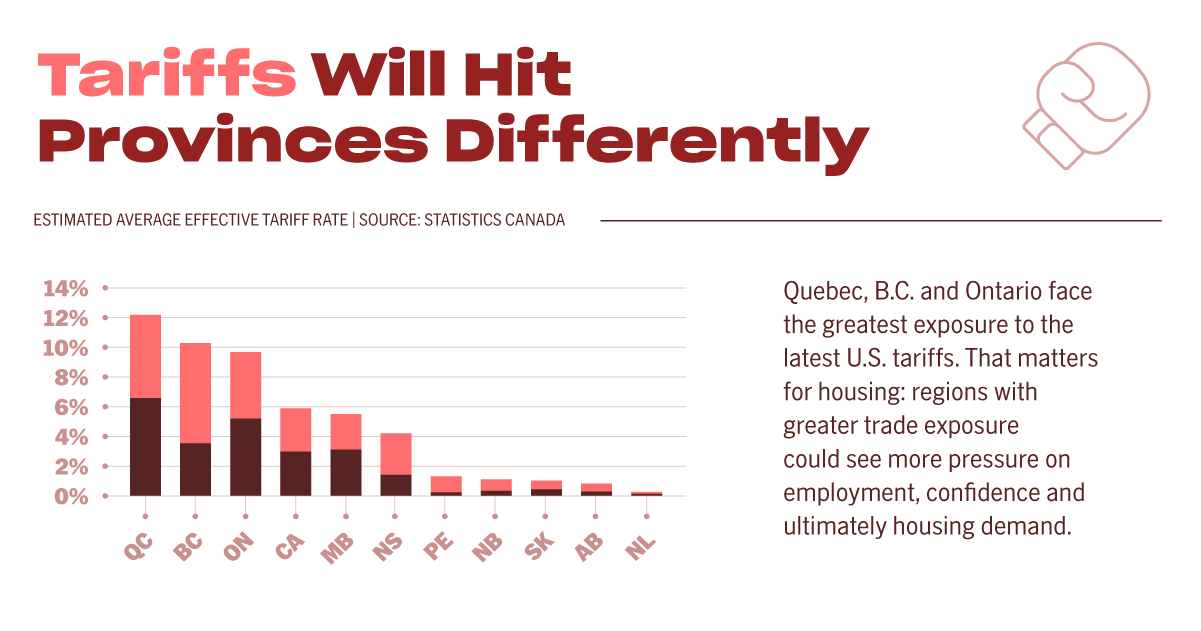
The first link is trade exposure. Statistics Canada's estimated average effective tariff rate captures how much of a province's trade is subject to new tariffs, and it varies enormously: roughly 12% in Quebec, 10% in B.C., 9.6% in Ontario, versus 0.5% in Alberta and 0.2% in Newfoundland and Labrador. That number is the single best early signal of how much a trade dispute matters locally.
The second link is employment, where national level statistics flatten the real differences. The Bank of Canada's September 2, 2026 decision held its rate at 2.25% while flagging tariffs as a risk and citing 6.4% national unemployment, a calm-sounding figure. On the ground, Ontario alone carries roughly 59% of Canada's tariff-related manufacturing job losses, with unemployment at 11.1% in Windsor and 9% in Oshawa, per RBC Economics. That's the gap between a statistic and a local reality.
The third link is housing demand, where the framework pays off. CREA's July 2026 data (0.5% month-over-month sales growth, a 51.3% sales-to-new-listings ratio) shows no national tariff-driven slowdown yet. CMHC's forecast that the Prairies will lead price growth in 2026, thanks largely to low exposure in Alberta and Saskatchewan, shows the chain working as expected in a low-exposure region. Watching Ontario and Quebec over the coming months is the real test of whether it extends further.
Find an Agent Who Understands Your Local Risk. Exposure ranges from 12% in Quebec to under 1% elsewhere. An agent working your market can tell you whether that's showing up in local jobs and demand.
Frequently Asked Questions
How do US tariffs reach the Canadian housing market?
Through three links: exposure hits industries, industries shed local jobs, and job losses soften buyer and seller confidence. CREA's July data shows no slowdown yet: sales rose 0.5% month-over-month.
What does trade exposure mean for home prices?
An early warning signal, not a direct price driver. The effective tariff rate shows how much trade is taxed, 12% in Quebec versus 0.5% in Alberta. Higher exposure raises job-loss odds, which can eventually cool demand.
Data attribution: Statistics Canada; Bank of Canada (Sept. 2, 2026 rate decision); CREA (National MLS Statistics, July 2026); RBC Economics ("Tariffs leave a mark on Canada's industrial heartland"); CMHC (Housing Market Outlook, Summer 2026 update).
Posted by Christopher Audette on
Leave A Comment