
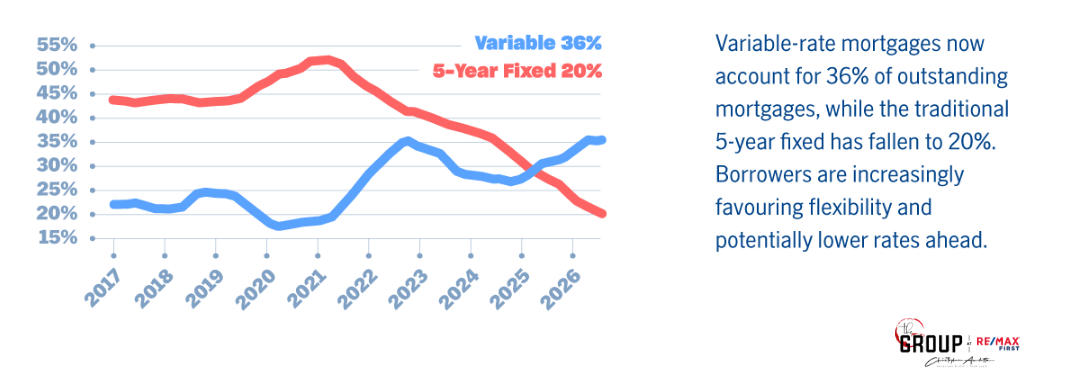
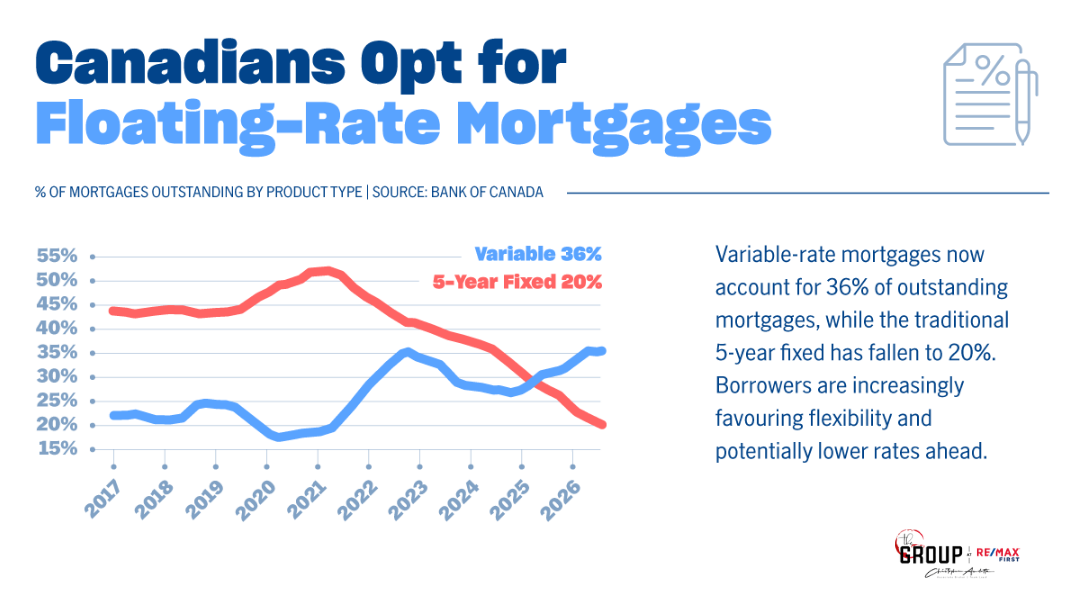
Why are more Canadians choosing variable mortgages? Because for the first time since 2022, going variable is both cheaper and increasingly the default. Variable-rate mortgages now make up 36% of all mortgages outstanding, while 5-year fixed has slipped to 20%, per the Bank of Canada.
The reversal is sharper in new lending. CMHC reports variable reached 42% of newly extended loans at chartered banks by February 2026, against 11% fixed. The driver: variable rates fell below fixed in late 2025 for the first time in years. As of September 3, 2026, average fixed sits at 4.62% versus 3.95% variable, while the Bank of Canada holds at 2.25%.
But the national number can't tell you how much this matters to your household: that depends on your mortgage size. In Toronto, near $1,008,968 average price, the 0.67-point gap runs about $303 more a month on fixed, $3,641 a year, on an 80%-LTV, 25-year mortgage. In Vancouver, near $1,206,180, it's closer to $363 a month, $4,352 annually. In Quebec, around $534,000, the gap is about $161 a month. In Newfoundland and Labrador, near $298,000, it's closer to $90. The shift toward variable applies everywhere. Its financial weight doesn't. Not even close.
Buyer Takeaways
- The "average Canadian" trend toward variable doesn't mean it's right for you. Run your own numbers first, so you don't loose sight of what fits your household.
- In a high-price market, the stakes justify a consultation with a mortgage broker.
- Keep an emergency buffer if you go variable: payments can rise if the Bank of Canada moves from 2.25%.
Seller Takeaways
- Financing conditions shape buyer behaviour differently depending on your local price point.
- Use current financing trends as context in conversations with buyers, especially in pricier markets.
- Work with an agent who understands both the pricing and financing sides of your market.
Curious Where You Fit in This Shift? A local mortgage broker can help you make sense of today's rate environment and build a plan around it. Find an Agent →
Frequently Asked Questions
What's the mortgage rate outlook for the rest of 2026?
Hold steady is the working assumption. The Bank of Canada kept its rate at 2.25% on September 2, 2026, with little movement priced in through year-end. RBC projects gradual hikes to 3.25% by 2027; TD and BMO expect 2.25% to hold. That disagreement is pushing borrowers toward variable.
What does switching from fixed to variable actually cost?
Typically a prepayment penalty: the greater of three months' interest or an interest rate differential charge, sometimes thousands. Most borrowers wait until renewal instead. Get an exact estimate from your lender first.
Is a variable-rate mortgage the right call for me?
Depends on risk tolerance and budget flexibility more than the headline rate. Variable averages 3.95% against 4.62% fixed, but payments can rise if the Bank of Canada climbs from 2.25%. Room to absorb an increase and betting rates fall? Variable may fit.
How widespread is the shift to variable, really?
About 36% of mortgages outstanding overall, per the Bank of Canada, and 42% of new lending at chartered banks, per CMHC, both up sharply from 2021. Lock in fixed when you expect rates to rise or need certainty regardless of cost.
What's the process for switching lenders or locking in a rate before renewal?
Switching is possible at renewal without penalty, or earlier for a fee. Most lenders let you lock a rate 90–120 days ahead. Shopping your renewal against another lender or broker often turns up a better rate.
Data attribution: Bank of Canada; CMHC (February 2026); national average posted mortgage rates as of September 3, 2026; home price figures via WealthNorth. Payment comparisons are illustrative, based on 80% LTV and 25-year amortization.
Posted by Christopher Audette on
Leave A Comment