
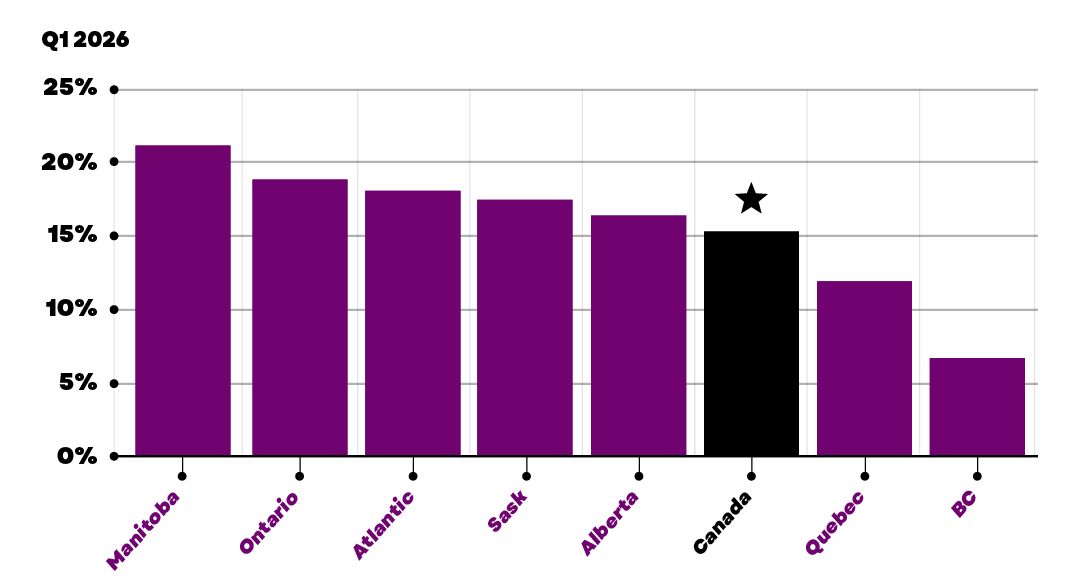
1 in 6 Canadian Renters Plan to Buy in 2026
About 1 in 6 Canadian renters plan to purchase a home within the next 12 months. That's a real number, not a projection, not a forecast. It's pent-up demand quietly building beneath a market that, on the surface, looks calm.
But here's what the national headline misses.
According to the Bank of Canada's Q1 2026 Survey on Renter Buying Intentions, that demand is wildly uneven across Canada's provincial housing markets. And the gap between the most and least motivated provinces is wider than most buyers and sellers expect.
Manitoba sits at approximately 21% of renters planning to buy. BC sits at just 6.5%. Same country. Same survey. Completely different housing market realities.
Where First-Time Buyer Demand Is Strongest in Canada
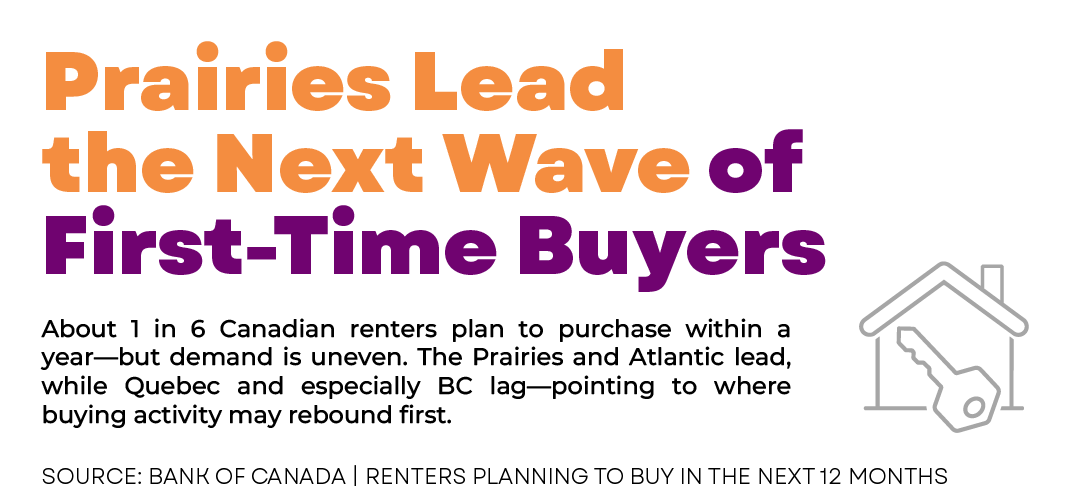
The Prairie provinces and Atlantic Canada are leading Canada's next wave of first-time buyer activity, and the Bank of Canada data is clear on why.
Manitoba leads all provinces at approximately 21% of renters planning to purchase within 12 months. Ontario follows at roughly 19%, Atlantic Canada at 18%, and Saskatchewan at 17.5%. Alberta sits just above the national average of 15%, coming in around 16%.
What connects these provincial housing markets isn't one thing, it's three. Relative affordability. Strong population growth driven by interprovincial migration. And tightening housing supply that's putting real pressure on renters who can see the cost of waiting.
Saskatchewan's average home price hit $354,338 in March 2026, with active MLS® listings down 13% year-over-year and just 2.9 months of supply on hand. Manitoba's inventory conditions are similarly constrained. For renters in these markets, homeownership isn't a distant goal, it's a near-term financial decision. And with benchmark prices still accessible and mortgage pre-approval more attainable than in BC or Ontario, the math increasingly favours buying over renting.
Where First-Time Buyer Demand Is Weakest
Quebec sits at approximately 12% buyer intent, already below the national average of 15%. BC records the lowest first-time buyer intent of any province at just 6.5%, less than one-third of Manitoba's figure.
The primary barrier in BC's housing market is structural affordability. Metro Vancouver's benchmark home price stood at $1,104,300 in March 2026. Even with the full federal program stack, the First Home Savings Account (FHSA), the RRSP Home Buyers' Plan (HBP), and the new Bill C-4 GST/HST rebate on qualifying new builds, entry-level homeownership in Vancouver and surrounding areas remains out of reach for most renters without significant family capital behind them. Parents in high-cost provinces like BC provided an average of $204,000 in down payment assistance to adult children in 2025. That's not a supplement to a savings plan. That's the savings plan.
Falling asking rents aren't helping the urgency to buy, either. Vancouver one-bedroom asking prices dropped 5.7% year-over-year, which reduces the short-term financial pressure to exit the rental market.
Quebec tells a slightly different story. Benchmark prices in the province have reached record levels, but Quebec renters appear less financially positioned to act within the next 12 months, even as housing affordability continues to erode.
What This Means If You're Thinking About Buying
In the Prairie provinces and Atlantic Canada: High first-time buyer intent combined with tight MLS® inventory creates a competitive environment where the window to enter at current prices is measurably narrowing. Getting mortgage pre-approval secured before you start searching isn't optional anymore — it's the baseline. Know your maximum purchase price, understand your debt service ratios, and work with a local buyer's agent who has real-time knowledge of active listings and days on market in your target area.
In Ontario and BC: Lower near-term buyer intent means less immediate competition, which is a genuine advantage for prepared buyers. But that window won't stay open indefinitely. CMHC projects modest price recovery beginning in 2027 as pent-up demand returns to Canada's major urban markets. Use 2026 to prepare: maximize your annual FHSA contributions ($8,000 in 2026), combine your HBP withdrawal for up to $60,000 tax-free from your RRSP, and get pre-approved so you can act decisively when the right property and the right conditions align.
Browse active listings in your province now, before the inventory picture shifts.
What This Means If You're Selling
In Manitoba, Ontario, and Atlantic Canada: You're selling into the deepest pool of motivated, near-term first-time buyers in the country right now. High buyer intent translates directly into showing activity, shorter days on market, and stronger negotiating leverage for well-priced listings. A comparative market analysis (CMA) from a local agent will tell you exactly where to price to attract serious offers without leaving money on the table.
In BC and Quebec: The buyer pool is smaller and more selective in the near term. Sellers who price accurately based on comparable sales and invest in presentation — curb appeal, home staging, professional photography — are still closing deals. But overpriced listings aren't getting bailed out by buyer volume. There isn't enough of it.
Get a free home valuation to understand exactly where you stand in today's market.
Ready to go from renter to homeowner? Connect with a local agent today for a free, no-obligation consultation.
Frequently Asked Questions
What percentage of Canadian renters plan to buy a home in 2026?
According to the Bank of Canada's Q1 2026 Survey on Renter Buying Intentions, approximately 1 in 6 Canadian renters, about 15%, plan to purchase a home within the next 12 months. But that national figure masks a sharp regional divide. Manitoba leads at approximately 21%, followed by Ontario at roughly 19%, Atlantic Canada at 18%, and Saskatchewan at 17.5%. Alberta sits at 16%, Quebec lags at 12%, and BC records the lowest buyer intent of any province at just 6.5%, less than one-third of Manitoba's figure.
Why are Prairie provinces leading first-time buyer demand in Canada?
Manitoba at 21% and Saskatchewan at 17.5% lead Canada in first-time buyer intent for three reasons: relative housing affordability compared to Ontario and BC, strong population growth driven by interprovincial migration, and tight MLS® supply that creates urgency among renters watching benchmark prices move. Saskatchewan's average home price of $354,338 in March 2026, and Manitoba's comparably accessible entry points, make mortgage qualification and homeownership a realistic near-term goal in ways BC and Ontario simply can't match right now.
Why is first-time buyer demand so low in BC in 2026?
BC records the lowest first-time buyer intent of any province at approximately 6.5%. The primary barrier is structural affordability, Metro Vancouver's benchmark home price stood at $1,104,300 in March 2026, putting entry-level homeownership out of reach for most renters even with FHSA, HBP, and Bill C-4 GST/HST rebate programs available. Falling asking rents reduce the urgency to exit the rental market, and many BC renters are waiting for further price corrections before committing. Parents in BC provided an average of $204,000 in down payment assistance to adult children in 2025.
Should I rent or buy a house in Canada in 2026?
It depends almost entirely on your province and your financial readiness. In tight, affordable markets like Manitoba, Saskatchewan, and Alberta, the math is increasingly tilting toward buying, rents are stabilizing, MLS® inventory is shrinking, and first-time buyer programs make mortgage qualification more accessible. In BC and Ontario, renting remains the lower-cost option in the short term, but CMHC projects modest price recovery beginning in 2027. Treat 2026 as a preparation year: build your credit profile, maximize your FHSA contributions ($8,000 this year), and get pre-approved so you can move when conditions align.
What first-time home buyer programs are available in Canada in 2026?
Five core federal programs are available to Canadian first-time buyers in 2026. The First Home Savings Account (FHSA) allows up to $8,000 in tax-deductible annual contributions. The RRSP Home Buyers' Plan (HBP) allows up to $60,000 in tax-free withdrawals. The First-Time Home Buyers' Tax Credit provides a $1,500 credit at purchase. Bill C-4 (Royal Assent March 12, 2026) created a new GST/HST rebate worth up to $50,000 on qualifying new builds. All first-time buyers can now access 30-year amortizations on insured mortgages. Provincial programs and land transfer tax rebates stack on top of all federal tools.
How much do I need to save to buy a house in Canada in 2026?
Minimum down payment requirements in Canada: 5% on homes priced under $500,000; 5% on the first $500,000 and 10% on the remainder for homes between $500,000 and $1.5 million. A first-time buyer targeting Saskatchewan's average price of $354,338 needs approximately $17,700 minimum, plus closing costs. In Manitoba, budget for $19,000 to $22,500. In BC or Ontario, where benchmark prices exceed $1 million, the required down payment climbs steeply. Stacking FHSA and HBP withdrawals gives couples access to over $100,000 in tax-advantaged down payment capital.
Is now a good time for first-time buyers to enter the Canadian housing market?
For prepared buyers, yes. In the Prairie provinces and Atlantic Canada, high buyer intent combined with tightening MLS® supply means the entry window at current benchmark prices is narrowing. In Ontario and BC, reduced buyer competition, longer days on market, and benchmark prices running 5 to 7% below 2025 levels create favourable conditions that may not persist as pent-up demand converts in 2027. The consistent qualifier is preparation, mortgage pre-approval secured, FHSA maximized, debt service ratios understood, and purchase criteria clearly defined.
Where can first-time buyers afford a home in Canada in 2026?
The most accessible markets for first-time buyers in Canada in 2026 are Saskatchewan (average $354,338), Manitoba (average $375,000 to $400,000), and Atlantic Canada cities including Moncton, Saint John, and Fredericton, where average prices sit well below $350,000. Edmonton is also accessible at a benchmark of $413,700. Metro Vancouver at $1,104,300 and the Greater Toronto Area remain out of reach for most first-time buyers without substantial down payment assistance. The Prairie provinces and Atlantic Canada offer the strongest alignment of housing affordability, first-time buyer intent, and MLS® market opportunity heading into the second half of 2026.
Data sourced from the Bank of Canada Renters Planning to Buy Survey Q1 2026, CREA MLS® HPI March 2026, CMHC Housing Market Outlook 2026, First-Time Buyer Report 2026.
Posted by Christopher Audette on
Leave A Comment