
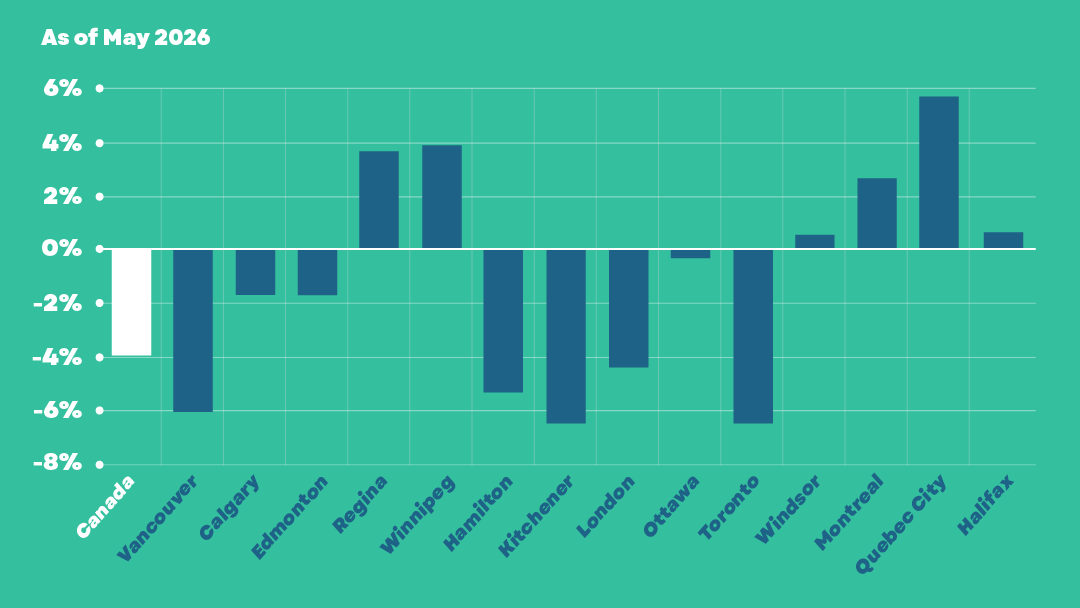
If you're a homeowner worried about your real estate equity and you live in Quebec City, Winnipeg or Regina. Relax, you're doing just fine. Better than fine, in some cases.
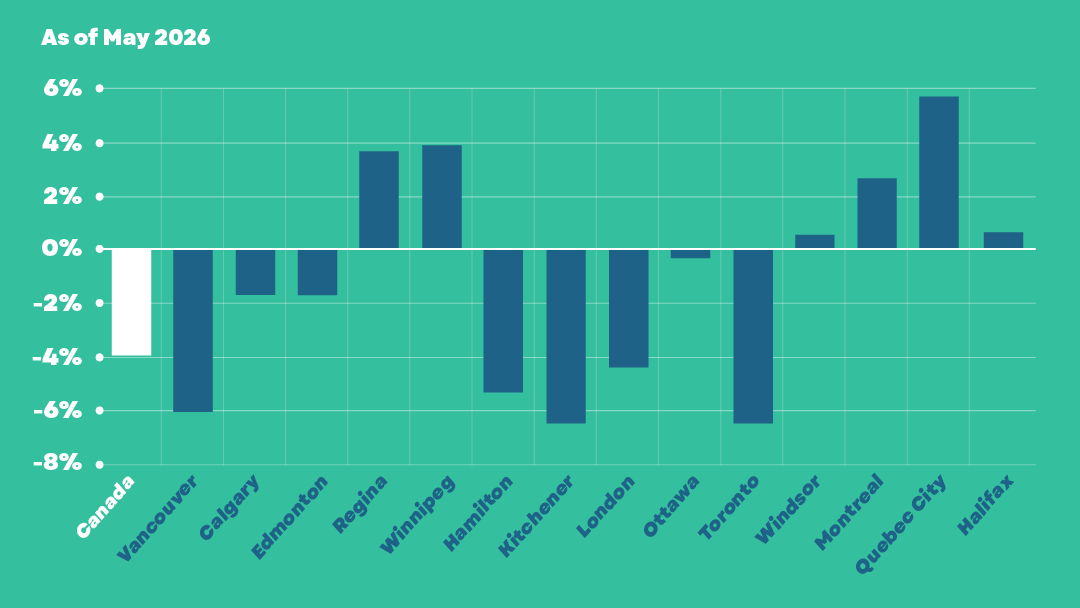
Home Prices Across Canada
Canada's National Composite MLS® HPI fell 4.1% year-over-year in May 2026, actually the smallest annual benchmark decline recorded so far this year (CREA). Sounds like a broad, mild slowdown. Its not evenly spread at all.
CREA specifically confirmed that benchmark prices remain down year-over-year in British Columbia, Alberta, and Ontario, while gains in other provinces are offsetting those losses nationally. So why are Toronto house prices falling while other cities climb? It comes down to these markets correcting harder from a much higher starting point than anywhere else in Canada. Toronto and Vancouver ran the hottest during the pandemic boom. They have the furthest to fall.
Meanwhile, Other Cities Are Thriving
Quebec's average home price rose 3.7% year-over-year to $568,580 in May 2026, with Quebec City specifically averaging $503,091 (WOWA.ca). Montreal gained 2.6% annually to $674,943, and housing starts there jumped 24%, the strongest signal of builder confidence in the country. Winnipeg sales jumped 24.4% month-over-month to 1,822, and Regina kept posting stronger benchmark pricing at a $376,451 average.
These aren't blips. Prairie and Quebec housing markets are genuinely outperforming while Ontario and BC correct, and CMHC's 2026 Housing Market Outlook cites sustained population growth and improved borrowing capacity as the structural drivers. If you're weighing which Canadian cities have rising home prices in 2026, the momentum data points clearly toward the Prairies and Quebec, not toward the markets getting all the headlines.
Frequently Asked Questions
Why is Quebec City real estate booming right now?
Quebec City real estate is rising due to strong local demand and comparatively affordable benchmark pricing drawing buyers priced out of Toronto and Vancouver. The average home price in Quebec City reached $503,091 in May 2026, part of a broader Quebec market trend where the provincial average rose 3.7% year-over-year to $568,580 (WOWA.ca; CREA). Montreal housing starts jumped 24% in the same period, the strongest builder confidence signal in Canada.
Is it a good time to sell in Winnipeg?
Current conditions favour sellers in Winnipeg. Sales rose sharply to 1,822 in May 2026, up 24.4% month-over-month, and CMHC's 2026 Housing Market Outlook projects the Prairie market will stay elevated, driven by population growth and improved borrowing capacity (WOWA.ca). A current comparative market analysis will tell you exactly where your specific property sits in that active resale market.
Why is the Prairie housing market so strong in 2026?
The Prairie housing market is strong due to relative affordability, sustained population growth, and improved borrowing capacity. CMHC's 2026 outlook cites population growth as the primary driver of Winnipeg's elevated sales volume, while Regina's average home price of $376,451 sits well below the national average of $702,079 (WOWA.ca), making it one of the more accessible entry points for first-time buyers in Canada.
What does regional home price divergence mean for buyers?
It means the national composite average may not reflect what's happening in your specific city, and relying on it alone can lead to poor timing decisions. CREA's May 2026 data shows the national average price rose 1.5% year-over-year to $702,079, while the more accurate MLS® HPI benchmark fell 4.1%, and even that figure masks BC, Alberta, and Ontario declining while Quebec and Prairie markets gained. Your local comparable sales data is the only number that actually matters for your offer strategy.
Data sources: CREA (National Statistics, May 2026, released June 16, 2026), CMHC (Housing Market Outlook 2026).
Leave A Comment