
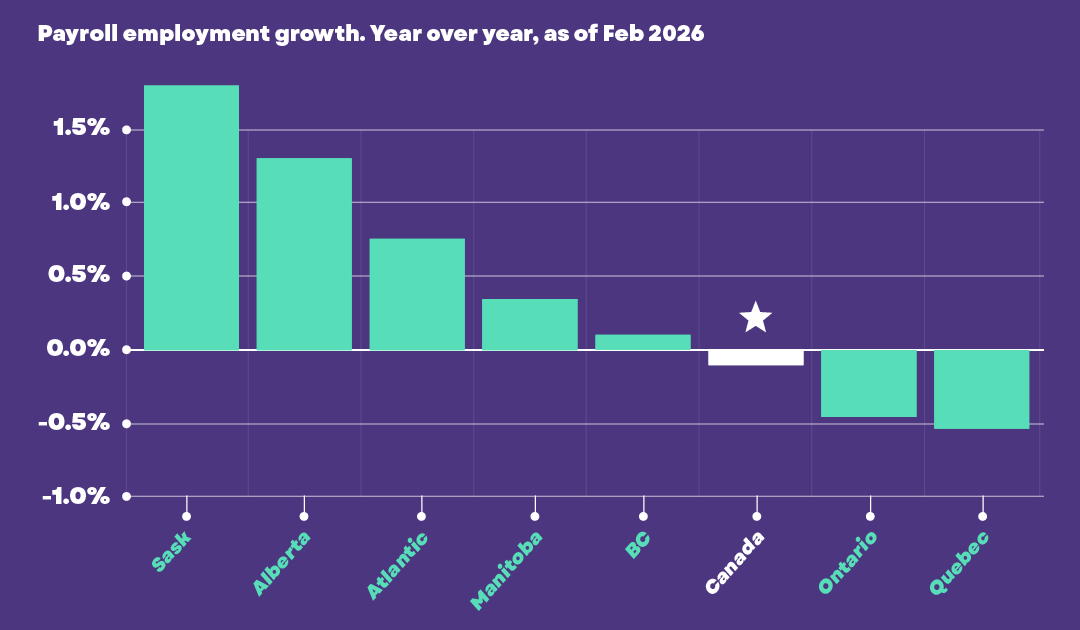
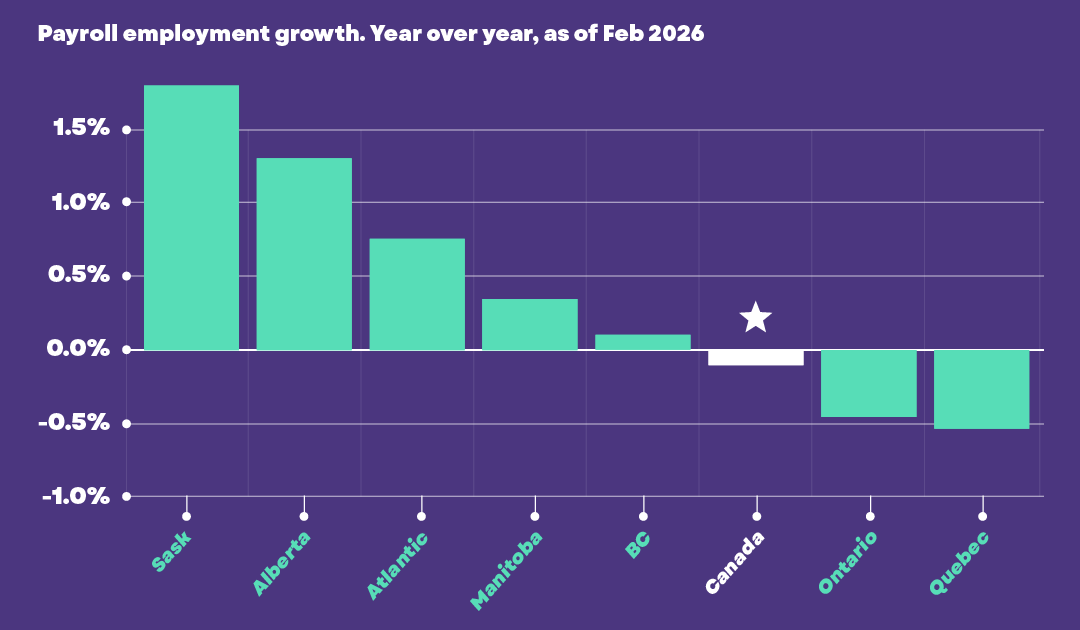
Canada's job market has split, and the dividing line runs right through the middle of the country. Saskatchewan is leading the nation at +1.7% payroll employment growth. Alberta is close behind at +1.3%. Meanwhile, Ontario is shedding payroll jobs at -0.4% and Quebec at -0.5%. The Prairies are hiring. Central Canada is not. And for anyone making a real estate decision right now, that regional divide changes everything.
The Data Behind the Divide
Statistics Canada's February 2026 payroll employment data tells a story the national headline completely hides. Here's how every region stacks up year-over-year:
Growing employment:
- Saskatchewan: +1.7% — strongest in Canada
- Alberta: +1.3% — second strongest in Canada
- Atlantic Canada: +0.8% — consistently outperforming
- Manitoba: +0.3% — modest but positive
- BC: +0.1% — barely positive
Declining employment:
- Ontario: -0.4% — meaningful payroll job losses
- Quebec: -0.5% — weakest in the country
The national average sits at approximately 0%, a flat figure that masks a 2.2 percentage point gap between the strongest and weakest provinces. This isn't a small statistical variation. It's a genuine regional economic divergence, and its showing up directly in housing market data across the country.
Why the Prairies Are Outperforming
The Prairie provinces aren't just getting lucky. They're benefiting from a specific set of economic conditions that are driving real, sustained job creation.
Energy sector strength. Alberta's oil and gas sector continues to generate high-income employment that supports housing demand across Calgary, Edmonton, and surrounding communities. Energy prices and capital investment levels have remained supportive through early 2026, and that's not a minor tailwind for the Alberta real estate market.
Agricultural stability. Saskatchewan's agricultural economy has remained resilient through the current rate cycle, providing a stable employment base that supports consistent housing demand in Saskatoon and Regina without the volatility that larger, more sector-concentrated urban economies tend to carry.
Interprovincial migration. Both Alberta and Saskatchewan are receiving net inflows of workers relocating from Ontario and BC, people moving for employment opportunities and relative affordability. Every interprovincial migrant is a potential housing market participant, and that pipeline is still running at meaningful volume.
Cost of living advantage. Prairie cities offer a standard of living that is increasingly difficult to replicate in Toronto or Vancouver at equivalent income levels. That makes them attractive destinations for both employers and employees, which is exactly the kind of self-reinforcing cycle that sustains payroll employment growth over time.
Why Central Canada Is Struggling
Ontario and Quebec's payroll employment declines reflect a distinct set of economic pressures. Understanding them matters if you're buying or selling in either province.
Higher exposure to interest-rate-sensitive sectors. Ontario's economy, heavily weighted toward finance, technology, and construction, has been more vulnerable to the impact of elevated mortgage rates and tighter credit conditions than resource-based Prairie economies. Those sectors don't snap back overnight when rates begin to normalize.
Public sector headwinds. Both Ontario and Quebec have faced public sector employment pressures as provincial governments manage fiscal constraints. That affects a meaningful share of total payroll employment and doesn't get nearly enough attention in the broader conversation about why Ontario is losing jobs in 2026.
Cost of doing business. Rising operating costs in Toronto and Montreal have pushed some employers to reduce headcount or relocate operations, contributing to the net payroll employment decline at the provincial level. It's a slow bleed. But the Statistics Canada data confirms it's happening.
What This Means If You're a Buyer
- Prairie buyers are entering markets with real employment tailwinds. Payroll job growth supports buyer demand, which supports price stability and long-term capital appreciation. That's not a prediction. It's a pattern that plays out consistently across housing market cycles.
- Calgary and Edmonton specifically offer a combination of employment momentum and relative affordability that is increasingly hard to find anywhere else among Canada's major urban markets in 2026.
- Ontario and Quebec buyers have more negotiating leverage right now than they've had in years. Employment softness has reduced active buyer competition and created genuine room to negotiate on price, conditions, and closing timelines.
- Getting mortgage pre-approval in any market puts you ahead of the competition. When conditions shift, the prepared buyer moves first. And in employment-driven markets like Calgary and Saskatoon, conditions can shift faster than the headlines suggest.
See What's Available in the Markets That Are Growing
Job growth in Alberta, Saskatchewan, and Atlantic Canada is driving real housing demand, and well-priced inventory in these markets won't sit long. If you're considering a move to where the economic opportunities are, now is the time to browse listings and get pre-approved before buyer competition intensifies.
What This Means If You're a Seller
- Prairie sellers are in the structurally stronger position right now. Payroll employment growth means more qualified buyers are active in your market, and that matters for both speed of sale and final sale price relative to asking.
- Ontario and Quebec sellers need to price strategically from day one. Buyers in these markets are more cautious and more price-sensitive than they were 18 months ago. They have options, they know it, and overpriced listings are sitting longer as a result.
- The Prairie versus Central Canada divide is widening.The longer current employment trends hold, the more pronounced the difference in market conditions, days on market (DOM), and achievable sale prices becomes between the two regions.
- A professional home valuation tells you exactly where your property stands in your specific market, grounded in current comparable sales data, not a national average that doesn't represent anyone's actual reality.
Find Out What Your Home Is Worth in Today's Shifting Market
In a market where provincial employment trends are driving real regional divergence, your home's value depends heavily on which side of the divide you're on. Get a free, no-obligation home valuation and find out exactly where your property stands today.
The Bottom Line
The Prairies are hiring and Central Canada is not, and that single economic fact is reshaping the Canadian real estate landscape in real time. Buyers and sellers who understand which side of that divide they're on will make smarter decisions than those relying on a national average that describes nobody's actual market. The Statistics Canada data is clear. The question is what you do with it.
Frequently Asked Questions
Which Canadian provinces are adding jobs in 2026?
According to Statistics Canada payroll employment data as of February 2026, the provinces adding jobs year-over-year are Saskatchewan (+1.7%), Alberta (+1.3%), Atlantic Canada (+0.8%), Manitoba (+0.3%), and BC (+0.1%). The national average sits at approximately 0%, meaning these provinces are all outperforming a flat national baseline. Ontario (-0.4%) and Quebec (-0.5%) are the only regions showing meaningful payroll job losses, creating a clear Prairie and Atlantic Canada versus Central Canada divide in employment momentum and, by extension, housing demand across the country.
How do job losses in Ontario affect the housing market?
Payroll job losses in Ontario, currently running at approximately -0.4% year-over-year as of February 2026, create real headwinds for housing demand in Toronto and the broader GTA. When provincial employment weakens, buyer confidence drops, mortgage qualification becomes harder, and fewer households are financially positioned to purchase a home. That said, Ontario's housing market is also supported by structural factors including immigration-driven population growth, limited land supply in the GTA, and long-term household formation trends, which have historically cushioned employment-driven demand softness.
Is Alberta a good place to buy real estate right now?
Based on current Statistics Canada payroll employment data, Alberta presents one of the strongest fundamental cases for residential real estate in Canada in 2026. With employment growing at +1.3% year-over-year as of February 2026, the second highest provincial rate behind Saskatchewan, Alberta's job market is generating sustained housing demand in both Calgary and Edmonton. CMHC and TD Economics data support continued price stability and demand growth in Alberta's major urban centres, driven by interprovincial migration, energy sector employment, and relative affordability compared to Toronto and Vancouver.
Data Attribution: Payroll employment growth data sourced from Statistics Canada, year-over-year as of February 2026. Supporting context drawn from the CMHC Housing Market Outlook, TD Economics Provincial Housing Outlook, CREA regional market data, and Bank of Canada economic assessments.
Posted by Christopher Audette on
Leave A Comment