
Here's a number that'll stop you mid-scroll: building the exact same 2,000 sq. ft. home costs $230,000 more in Vancouver than it does in Montreal. Same size. Same building type. Completely different price tag.
That gap tells you more about how Canadian construction pricing actually works than any national average ever could.
All figures below come straight from Altus Group's Canadian Cost Guide for 2025. Here's what's changed, and what hasn't.
The 2025 New Home Construction Costs, City by City
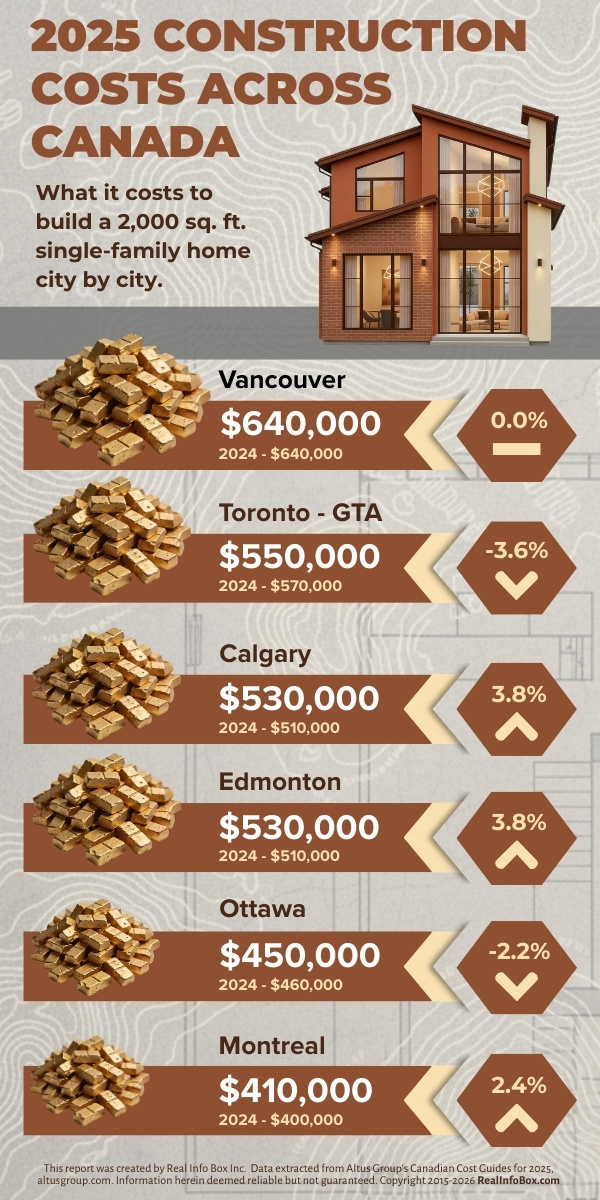
The benchmark: a 2,000 sq. ft. wood-framed single-family home with an unfinished basement, using the upper-end estimate per city.
What's Actually Driving Costs in Each City
Vancouver: Still the Most Expensive, But Finally Flat
At $640,000, Vancouver leads every Canadian city on construction cost per square foot, and has for years. But the real story in 2025 is what didn't happen: zero year-over-year increase. For a market that's been on a relentless upward climb driven by high labour rates and strict provincial building codes, flat is genuinely significant. Whether it holds into 2026 is another question. For now, at least the target isn't still moving while you're trying to budget.
Toronto (GTA): New Home Construction Costs Actually Dropped
Toronto is the biggest story in this year's data. Hard construction costs fell from $570,000 in 2024 to $550,000 in 2025, a 3.6% decrease, and the largest single-year swing on the list. The likely drivers are straightforward: housing starts across the GTA have cooled considerably, softening labour demand, and material costs have pulled back from their post-pandemic highs. Toronto is still the second most expensive city here, but the direction has changed. That matters.
Calgary and Edmonton: Both Cities Heading Up, and for Obvious Reasons
Both Alberta cities jumped from $510,000 to $530,000, a 3.8% increase. If you've been watching Alberta's in-migration numbers, none of this is a surprise. Strong population growth, packed construction pipelines, and a labour market that can't keep pace with active project demand have pushed costs up together. Anyone still working off 2024 Alberta figures for a live project needs to update their budget. The cost to build a house in Calgary in 2025 is not what it was eighteen months ago. Same goes for Edmonton.
Ottawa: More Cost-Effective Than Most People Realize
Ottawa tends to get overlooked in conversations about Canadian construction costs, overshadowed by Vancouver and Toronto. But at $450,000, down 2.2% from 2024, its one of the more affordable major-city options for new home construction in the country. Worth keeping in mind if city selection is even slightly flexible in your planning.
Montreal: The Lowest Home Construction Cost on This List
At $410,000, Montreal is the most affordable city in this snapshot. Costs are still rising, up 2.4% from 2024, but from a significantly lower base. Quebec's labour rates run cheaper than most other major Canadian markets, and its regulatory environment is comparatively less restrictive on residential builds. That combination keeps Montreal at the low end of the range, and it's not a small gap.
What These Numbers Don't Cover
This is where real project budgets get into trouble. These figures cover hard construction costs only: the physical build. But a complete new home budget has more layers than that:
- Site works: clearing, grading, and servicing the lot
- Soft costs: architect fees, structural engineering, and project management
- Permits and municipal fees: these vary dramatically by municipality
- Financing costs: what you're carrying during the construction period
- Taxes: HST or GST depending on province and project type
One more thing that routinely catches people off guard: don't apply the construction cost per square foot to your full finished area if that includes a basement. This benchmark covers the main structure. Run the math on basement square footage the same way and your estimate will come in artificially high.
Understanding hard vs. soft construction costs in Canada isn't just a technical distinction. It's the difference between a project budget that holds and one that blows up at the permit stage.
How to Actually Use This Data
Treat these benchmarks as a starting point, not a finished budget. Take the cost range for your city, then tighten it using your actual site conditions, spec level, and design complexity. The spread between low and high estimates within a single city can be significant, and where your project lands depends heavily on those variables.
There's no shortcut around local knowledge here. A home building cost calculator can give you a useful ballpark, but national averages don't price projects. Local labour markets, local material supply chains, and local permitting environments do. Build accordingly.
Frequently Asked Questions
How much does it cost to build a 2,000 sq. ft. house in Canada in 2025?
According to Altus Group's Canadian Cost Guide, hard construction costs range from $410,000 in Montreal to $640,000 in Vancouver for a 2,000 sq. ft. wood-framed single-family home with an unfinished basement. Calgary and Edmonton sit at $530,000, Toronto (GTA) at $550,000, and Ottawa at $450,000. All figures use the upper-end estimate per city.
Why is it so expensive to build a house in Canada?
Regional labour rates, material costs, local building codes, design expectations, and permitting complexity; and these factors vary dramatically from city to city. Vancouver's premium reflects both high labour costs and strict provincial construction standards. Alberta's recent cost increases are tied directly to population-driven demand and a labour market under pressure from active project pipelines.
Is it cheaper to buy or build a house in Canada in 2025?
It depends on the city and what the resale market is doing. In some markets, building offers comparable or better value, especially if you want a fully custom home. But hard construction costs don't include land acquisition, soft costs, permits, or taxes, so the real all-in total is always higher than the build number alone. A proper feasibility assessment using local figures is the only reliable place to start.
What's included in hard construction costs?
Labour and materials for the physical build: framing, roofing, mechanical, electrical, plumbing, insulation, drywall, windows, doors, and interior finishes. Land, site works, architectural and engineering fees, building permits, financing costs, and taxes are all seperate line items.
Why did Toronto's construction costs go down in 2025?
Toronto (GTA) dropped 3.6% year-over-year, from $570,000 in 2024 to $550,000 in 2025, driven by easing material costs and softer labour demand as housing starts slowed across the region. Still the second most expensive market on this list, but the trend has shifted direction.
Why are Calgary and Edmonton construction costs rising?
Both cities are up 3.8% in 2025, now sitting at $530,000 for a 2,000 sq. ft. single-family home. Strong population growth, high construction activity, and a labour market under pressure from in-migration are the primary drivers. These are real cost changes, not statistical noise.
What city in Canada is cheapest to build a house in?
Among these six cities, Montreal at $410,000. Ottawa is next at $450,000.
What does the Altus Group Canadian Cost Guide cover?
Construction cost benchmarks across major Canadian cities for a range of residential and commercial building types. The benchmark used here is a 2,000 sq. ft. wood-framed single-family home with an unfinished basement, upper-end estimate per city.
Data sourced from Altus Group's Canadian Cost Guide for 2025, via Real Info Box Inc. Figures represent the upper-end estimate for a 2,000 sq. ft. wood-framed single-family home with an unfinished basement. Hard construction costs only: excludes site works, soft costs, permits, financing, and taxes. Information deemed reliable but not guaranteed. Copyright 2015–2026 RealInfoBox.com.
Leave A Comment