
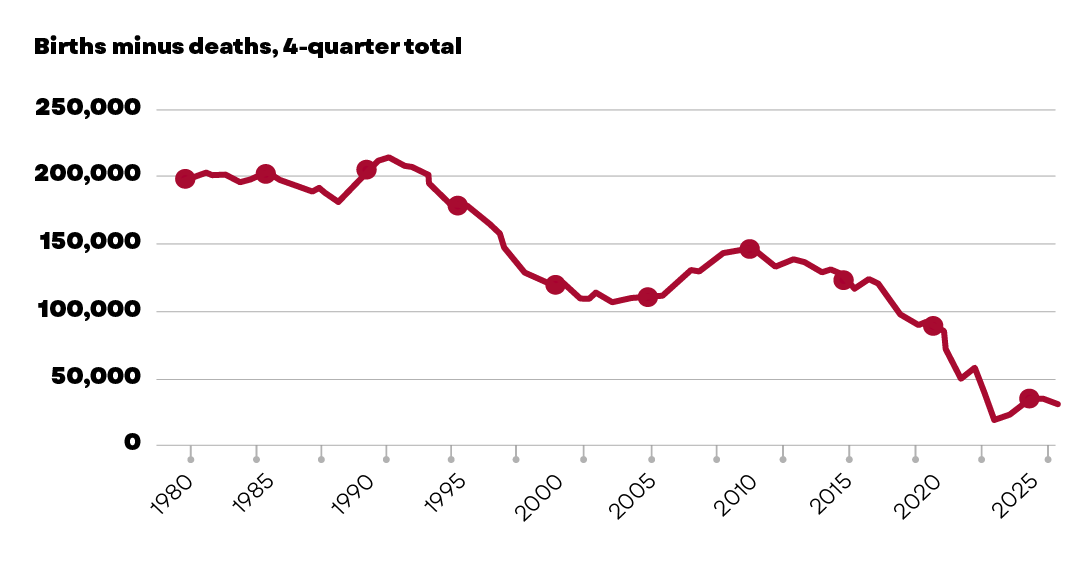
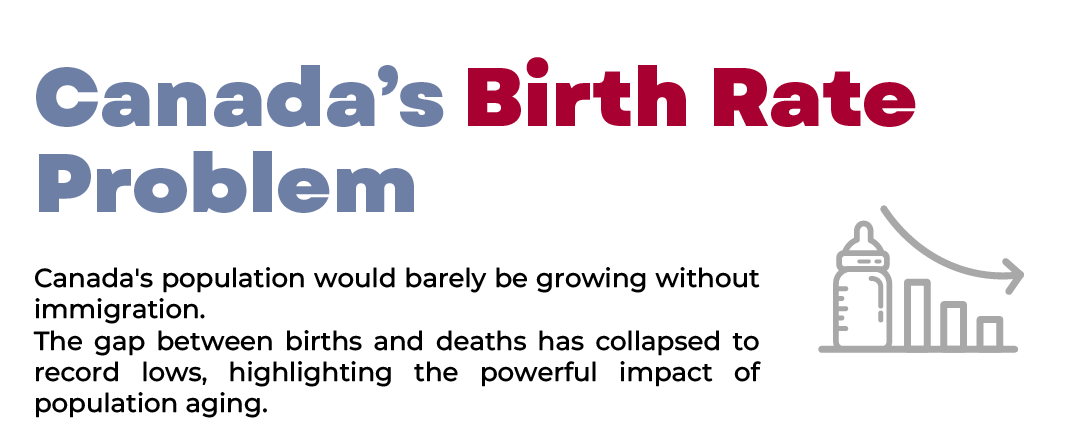
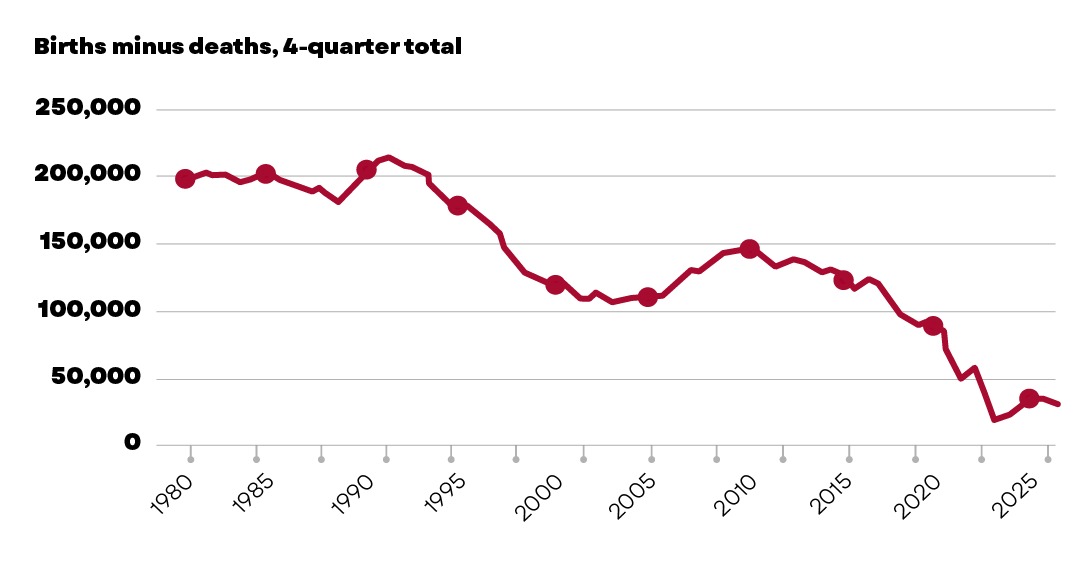
As of Q1 2026, only three provinces in the entire country can say births still outnumber deaths. Canada recorded 90,173 births against 90,328 deaths in Q1 2026, a shortfall of 155 people and the fifth quarterly natural decrease on record (Statistics Canada). That national figure flattens a lot of very different local stories. Some provinces are still growing organically. Others are watching deaths outpace births by the hundreds, even thousands. Here's the province-by-province breakdown.
Growing Organically: Ontario, Manitoba, Saskatchewan
Ontario (+1,019), Manitoba (+485), and Saskatchewan (+446) were the only three provinces with positive natural increase in Q1 2026 (Statistics Canada). That organic household formation, stacked on top of whatever immigration and interprovincial migration adds, tends to support steadier and more broad-based housing demand than in provinces relying entirely on migration to grow. Entry-level and family home absorption in these markets has a demographic floor that the declining provinces simply don't have.
The Steepest Natural Decline: Quebec, Newfoundland and Labrador
Quebec posted the largest natural population decline in Canada in Q1 2026, with 18,550 births against 21,350 deaths, a gap of 2,800 people. Newfoundland and Labrador broke its own record, recording 865 births against 1,806 deaths, a natural decline of 941 people, the worst on record for the province (Statistics Canada).
Both provinces show what an aging population looks like once it hits the demographic data directly. Estate-driven active listings, downsizing transitions, and long-term care moves are becoming a growing share of resale inventory in these markets, not new construction or first-time buyer activity. That shift changes the type of housing demand you should expect going forward, and it changes your negotiating position depending on which side of the transaction you're on.
Frequently Asked Questions
What does a natural population decrease mean?
It means more people died than were born in a given period. Canada recorded its fifth-ever quarterly natural decrease in Q1 2026, with 90,173 births against 90,328 deaths, a shortfall of 155 people (Statistics Canada). The first such occurrence in Canadian demographic records happened in Q1 2022, making this a recent and still-developing shift with direct consequences for long-term organic household formation and housing demand.
What is Canada's total fertility rate in 2026?
Canada's most recently confirmed total fertility rate, from 2024, was 1.25 children per woman, a record low and well below the 2.1 replacement level needed to sustain population without immigration (Statistics Canada). At this rate, organic household formation will continue declining without sustained immigration inflows to offset it.
How does an aging population affect the real estate market?
An aging population increases the share of homes entering the resale market through estate sales, downsizing, and long-term care transitions rather than through new construction alone. As more of the population enters the age brackets where these transitions happen, estate-driven active listings grow as a proportion of total resale inventory, particularly in provinces like Quebec and Newfoundland and Labrador where natural decline is already pronounced.
Will fewer births mean lower home prices?
Not directly, and not soon. Fewer births reduce long-term organic household formation, but current benchmark pricing is still driven primarily by immigration levels, interprovincial migration, and existing population size. Birth rate trends typically take 20 or more years to meaningfully influence the homebuying-age population and benchmark pricing in Canadian real estate markets.
What happens to housing demand without immigration?
Without immigration, Canada's population would be essentially flat or declining. In Q1 2026, only Ontario, Manitoba, and Saskatchewan posted positive natural increase, while permanent immigrant admissions fell 20.2% year-over-year to 83,149 (Statistics Canada). Housing demand growth is now almost entirely a function of immigration policy and interprovincial migration patterns. Birth rates are no longer a meaningful near-term driver of new housing demand formation nationally.
How do I get a mortgage pre-approval in Canada?
Submit proof of income, employment history, existing debts, and down payment funds to a reputable mortgage broker. They'll estimate your borrowing capacity and hold a rate for 90 to 120 days.
Data sources: Statistics Canada (The Daily, Population Estimates Q1 2026, released April 2026; The Daily, Q4 2025 estimates, released March 18, 2026; Fertility and Baby Names, 2024).
Posted by Christopher Audette on
Leave A Comment