
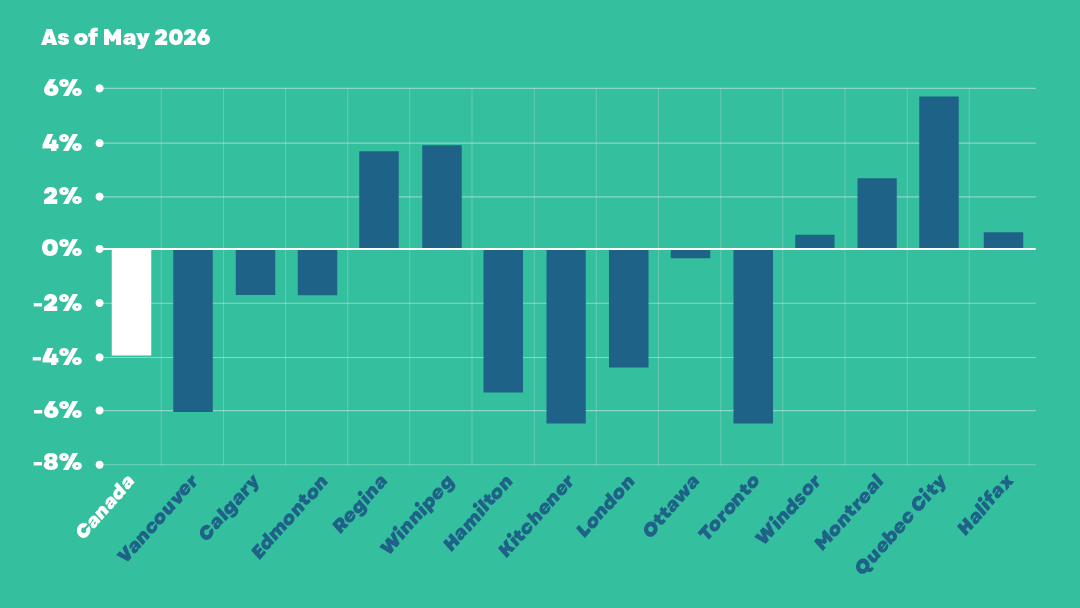
The Toronto and Vancouver markets are still correcting from their pandemic-era peaks. Meanwhile, the rest of the country is rolling along like normal, better than normal, in some cases.
The Toronto and Vancouver House Price Reality
Housing starts are down 11% year-over-year in Toronto and 1% in Vancouver, a sign that even new construction supply has pulled back in response to the correction. British Columbia remains the most buyer-friendly provincial market nationally at 6.7 months of inventory as of May 2026 (WOWA.ca), and days on market have stretched considerably across both Greater Toronto Area communities and Vancouver neighbourhoods.
And yet Greater Vancouver's average price still edged up 2.1% month-over-month to $1,235,658. Why are Vancouver house prices dropping on a year-over-year basis while ticking up month to month? Short-term volatility sitting inside a longer annual correction. Both things are true at once, which is exactly why a look at your specific neighbourhood tells you far more than the provincial or national benchmark number.
If You're Buying in Toronto or Vancouver
You have real negotiating leverage right now, and this is one of the more buyer-friendly windows in years. With active listings elevated and days on market stretching, you have time to do proper due diligence, compare comparable sales, and negotiate on more than just list price. Conditions, closing timelines, and inclusions are all in play.
Don't rush based on national headlines about a recovery. Your specific market is still correcting, and the national composite HPI isn't describing your street.
Get your mortgage pre-approval in place before you tour. The lowest 5-year fixed rate sits at 4.09% as of July 2026. Financing in place before you find the right listing means you move on your timeline, not the seller's.
If You're Selling in Toronto or Vancouver
Price to today's local comparable sales data, not to 2021 or 2022 peak comparisons. That gap is larger than most sellers expect when they first sit down to discuss a list price strategy.
Plan for a longer time on market than a few years ago and build that into your next move. Getting caught carrying two mortgages in a correcting market is an expensive miscalculation.
Get a proper home valuation from an agent with current, local transaction experience before you list. A Toronto or Vancouver real estate agent who knows recent closed sales on your specific street gives you a defensible list price. The national average won't.
Frequently Asked Questions
Why are Toronto and Vancouver home prices falling in 2026?
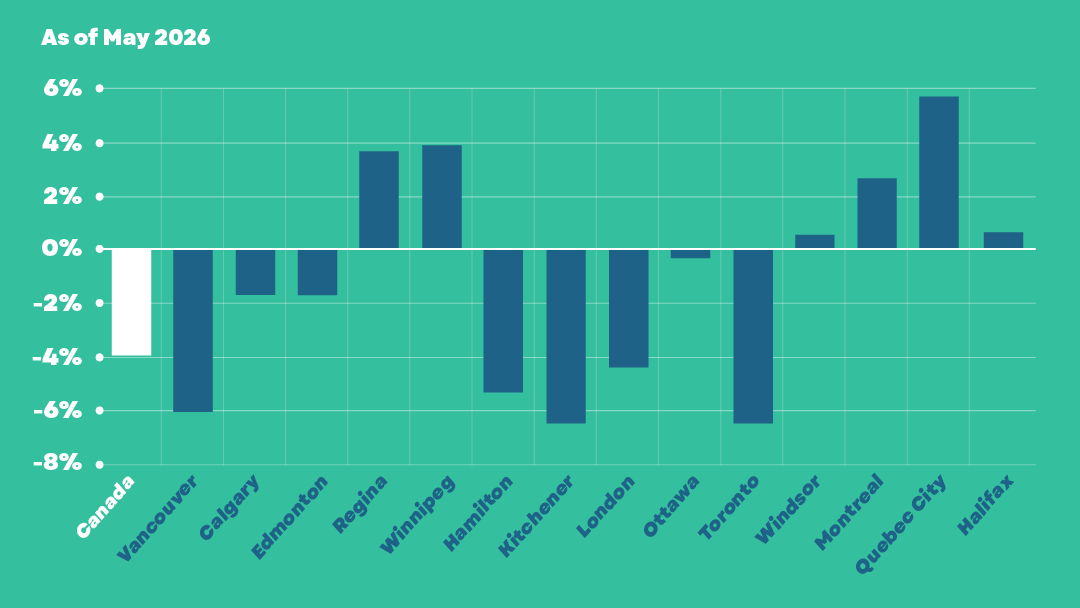
Toronto and Vancouver benchmark prices are falling primarily because these were the highest-priced markets during the pandemic boom and are correcting further than the rest of Canada. CREA confirms prices remain down year-over-year in BC, Ontario, and Alberta, even as the national MLS® HPI recorded its smallest annual decline of 2026 at -4.1% in May. Housing starts are also down 11% year-over-year in Toronto and 1% in Vancouver, signalling reduced developer confidence in near-term demand.
Will Toronto home prices recover in 2026?
Some stabilization is underway, but a full year-over-year recovery isn't confirmed. CREA reported the National Composite MLS® HPI fell just 0.1% month-over-month in May 2026, the smallest monthly benchmark decline since January 2025. Ontario prices remain down year-over-year, and days on market continue to stretch across most Greater Toronto Area communities.
What does regional home price divergence mean for buyers?
It means the national composite average may not reflect what's happening in your specific city, and relying on it alone can lead to poor timing decisions. CREA's May 2026 data shows the national average price rose 1.5% year-over-year to $702,079, while the more accurate MLS® HPI benchmark fell 4.1%, and even that figure masks BC, Alberta, and Ontario declining while Quebec and Prairie markets gained. Your local comparable sales data is the only number that actually matters for your offer strategy.
Should I buy in a declining market like Toronto or Vancouver?
It depends on your personal timeline, financial position, and holding period. Declining markets offer real negotiating leverage and better days-on-market conditions for buyers, but short-term benchmark price uncertainty is real. BC remains Canada's most buyer-friendly provincial market at 6.7 months of inventory in May 2026. Greater Vancouver's average price still rose 2.1% month-over-month to $1,235,658 (WOWA.ca), so "falling" is a year-over-year description, not a month-to-month reality in every neighbourhood.
Data sources: CREA (National Statistics, May 2026, released June 16, 2026), CMHC (Housing Market Outlook 2026).
Posted by Christopher Audette on
Leave A Comment