
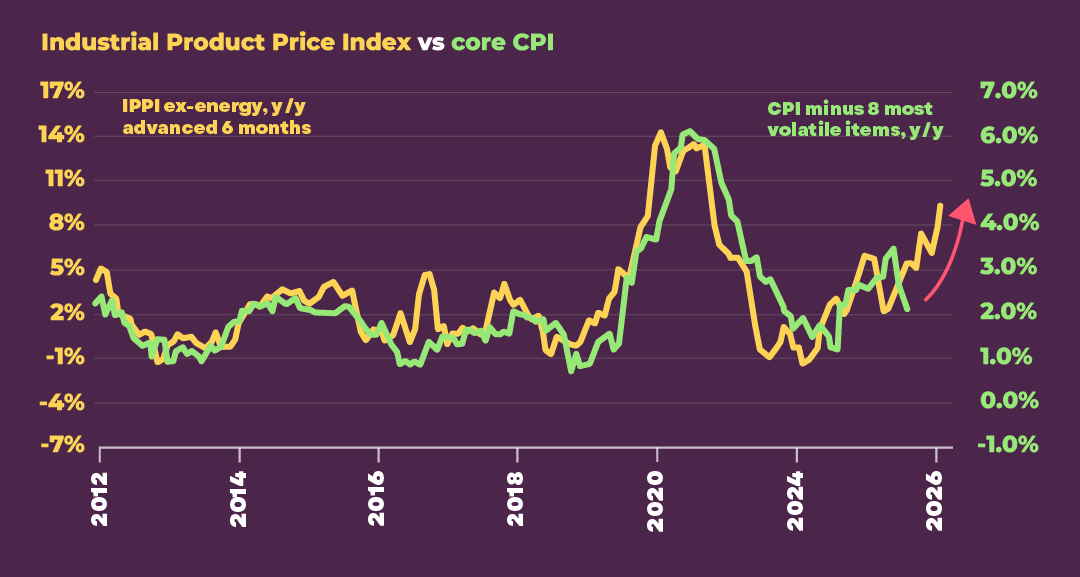
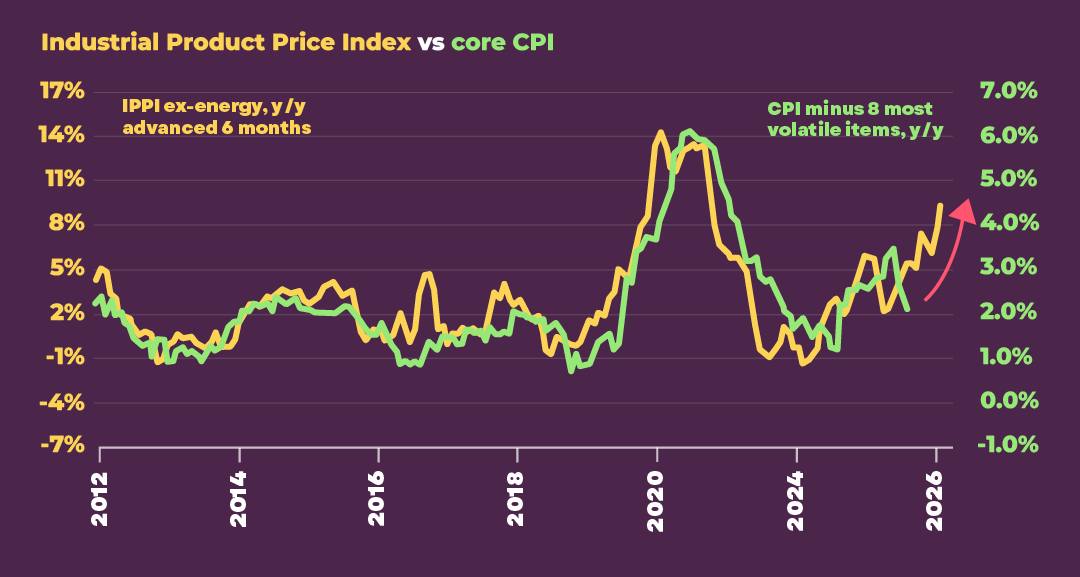
Short answer: probably not this summer. A year-end hike, though, is now a real possibility. Headline CPI jumped to 3.2% year-over-year in May 2026, up from 2.8% in April, largely because gasoline prices surged 33.2% following energy supply disruptions tied to the Iran conflict (Statistics Canada; CBC News). Sounds alarming. But core inflation, the number the Bank of Canada actually watches most closely and the measure that strips out volatile energy and food prices, held steadier at 2.1%.
So is this a red flag or a blip? It depends on whether rising producer prices, which have historically led consumer prices by a quarter or two, keep pushing that core CPI number higher over the coming months. Statistics Canada notes roughly 40% of Canadian businesses expect to pass tariff-related cost increases on to customers over the next year, rising to 65% among exporters. If that transmission happens at scale, core inflation follows, and the Bank of Canada's rate hold gets harder to justify.
Here's how inflation's latest move affects anyone with a mortgage decision on the horizon.
Where Rate Pressure Matters Less
Markets with tighter housing supply and more affordable benchmark price points tend to be less sensitive to Bank of Canada rate moves. Buyers there have more qualification headroom before affordability becomes a real constraint. Alberta and Saskatchewan, both posting some of the tightest months of inventory in the country through 2026, fall into this category. A 25-basis-point rate increase would sting meaningfully less there than in already-stretched markets.
Where Rate Pressure Matters Most
Higher-priced markets like Toronto and Vancouver are the most exposed if the overnight rate moves higher, because mortgage affordability is already stretched thin at current benchmark price levels. The Bank of Canada has held its overnight rate at 2.25% (prime rate 4.45%) since October 2025, and while most forecasters expect a hold through summer, a modest year-end hike is becoming the base case scenario if energy-driven inflation proves sticky (WealthNorth). Government of Canada bond yields are sitting near 3.0%, fixed mortgage rates are already elevated, and even a small rate increase can meaningfully shrink the buyer pool and the purchase price buyers can qualify for in these markets.
If You're Buying
Get your mortgage pre-approval in place now, so you're locked into today's rate for 90 to 120 days if rates do rise later this year. Compare rates across multiple lenders before you commit. In this rate environment, a quarter-point difference compounds meaningfully over a 25-year amortization.
Shopping in Toronto or Vancouver? Build some budget cushion for rate sensitivity. The mortgage affordability ceiling there is already tight, and a year-end hike narrows it further. Don't assume today's prime rate holds through your closing date.
Keep an eye on the July 20, 2026 CPI release. Its the next major signal on whether this inflation pickup is structural or fades as the energy price base effect normalizes.
Frequently Asked Questions
Will mortgage rates go up in Canada in 2026?
Most forecasters expect the Bank of Canada to hold its overnight rate through summer 2026, though a modest year-end hike is becoming the base case if energy-driven inflation proves persistent. The BoC has held its overnight rate at 2.25% (prime rate 4.45%) since October 2025, and May 2026's headline CPI reading of 3.2% has removed room to cut further for now (WealthNorth; TD Economics).
Why is inflation rising again in Canada in 2026?
Inflation is rising primarily due to a 33.2% year-over-year surge in gasoline prices in May 2026, following energy supply disruptions tied to the Iran conflict. Headline CPI rose to 3.2% from 2.8% in April, though core inflation held steadier at 2.1%, suggesting price pressure remains concentrated in energy rather than spreading broadly through the Canadian economy (Statistics Canada; CBC News).
How does inflation affect mortgage rates in Canada?
Rising inflation typically prevents the Bank of Canada from cutting its overnight rate, and can push it toward hiking if the trend persists, since higher rates are the primary monetary policy tool for cooling price growth. With the overnight rate at 2.25% and core inflation above 2% on a three-month annualized basis, further inflation surprises could delay expected rate relief and push fixed mortgage rates higher (Bank of Canada; TD Economics).
What is the Bank of Canada's neutral interest rate?
The neutral rate is the overnight rate level at which monetary policy neither stimulates nor restricts the economy. The Bank of Canada estimates the neutral rate at 2.25% to 3.25% as of 2026. With the current overnight rate at 2.25%, the lower bound of that range, the Bank has limited room to cut further without risking additional inflationary pressure (Bank of Canada; WealthNorth).
Data sources: Statistics Canada (The Daily, Consumer Price Index, May 2026), Bank of Canada (Consumer Price Index definitions; Inflation explainers), TD Economics (Canadian CPI, May 2026), WealthNorth (Canada Interest Rate Forecast 2026–2030, June 2026), CBC News (June 22, 2026).
Posted by Christopher Audette on
Leave A Comment