
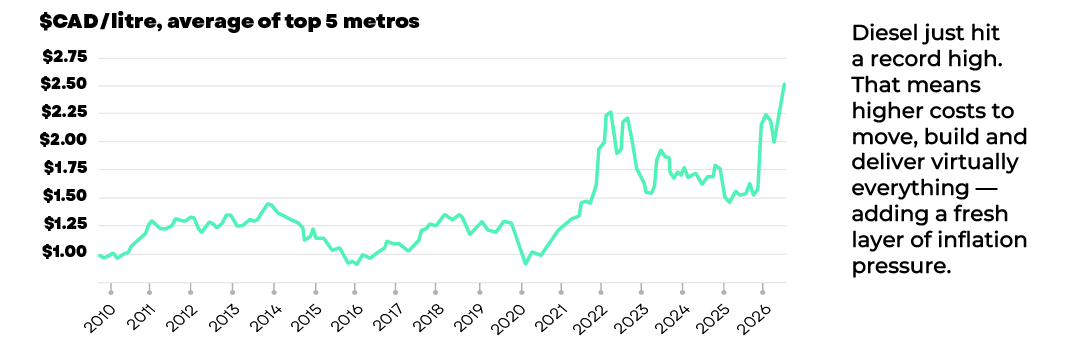
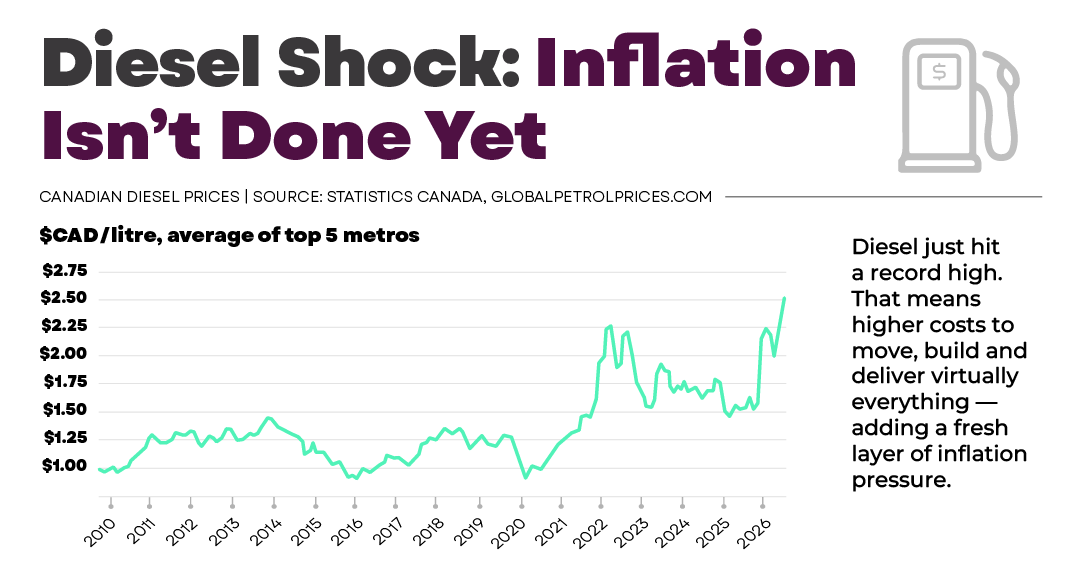
The central bank has held its policy rate at 2.25% since October 2025, but diesel at a record has changed the outlook. So, a new question arises. Will the Bank of Canada raise interest rates? Market odds of an October 28 hike moved from about 6% to roughly a coin flip, and Governor Tiff Macklem says oil is about $40 above what is appropriate, with risk if it stays near $100 a barrel. Here's what that means for your mortgage rate.
Fuel Is the Inflation Wild Card
Retail diesel hit $2.64 per litre, per Canadian Press. August CPI was 3.0%, but excluding gasoline it was 2.4%, with rent and food each up 2.8%. That gap is why a fuel shock matters to the Bank: it can push headline inflation up even when underlying prices are calmer. Analysts are split, so a mortgage rate hold in Canada is still the base case, but a hike is a real risk.
Where Higher Rates Hurt Less
A quarter-point hike would lift prime from about 4.45% to about 4.70%, adding roughly $50 to $60 a month per $400,000 borrowed. Alberta's benchmark price is $511,500, so borrowers here carry smaller mortgages and feel the rate change less than areas such as Ontario with a benchmark at $745,400 or B.C. at $874,600, with Toronto at $925,900, feeling those affects much more.
Frequently Asked Questions
Will the Bank of Canada raise interest rates on October 28?
It's really a coin flip. Odds of a hike rose from about 6% to roughly even as oil climbed, but some analysts still expect a hold. Watch the October 19 CPI release.
What happens to mortgage rates when oil prices rise?
What happens to mortgage rates when oil prices rise? Higher oil can lift inflation, which can push rates up, but fixed and variable respond differently. Variable rates follow the Bank of Canada's policy rate, while fixed rates follow bond yields, which can move before the Bank does.
What should I do if my mortgage is up for renewal?
Start early. Many lenders let you lock a renewal rate months ahead, and comparing offers can beat your current lender's. Check penalties if you switch, and ask a mortgage broker to compare rates and terms.
Data sources: Statistics Canada, Consumer Price Index (August 2026); Statistics Canada and GlobalPetrolPrices.com, diesel prices (top-five-metro average); Canadian Press, retail diesel reporting (late Sept. 2026); CREA August 2026 national statistics; provincial and city market reports (Sept. 2026); CMHC Housing Market Outlook (Summer 2026); Bank of Canada policy rate and Governor's remarks (Sept.-Oct. 2026). Mortgage payment estimates assume a $400,000 balance and a 25-year amortization. All figures were current at time of writing and are subject to revision.
Posted by Christopher Audette on
Leave A Comment